
UR-ENERGY INC.
2007 ANNUAL INFORMATION FORM
March 26, 2008
TABLE OF CONTENTS
PRELIMINARY NOTES
Date of Information
Unless otherwise indicated, all information contained in this Annual Information Form (“AIF”) of Ur-Energy Inc. (“Ur-Energy” or the “Corporation”) is as of March 26, 2008.
Financial Information
All financial information in this AIF is prepared in accordance with Canadian generally accepted accounting principles (“Canadian GAAP”).
Currency
All references in this annual information form to “dollars” or “$” are to Canadian dollars, unless otherwise indicated.
Forward-Looking Information
This AIF, including any documents incorporated by reference herein, contains certain “forward-looking statements”. All statements included in this AIF (other than statements of historical facts) which address activities, events or developments that management anticipates will or may occur in the future are forward-looking statements, including statements as to the following: future targets and estimates for production, capital expenditures, operating costs, mineral resources, recovery rates, grades and prices, business strategies and measures to implement such strategies, competitive strengths, estimated goals, expansion and growth of the business and operations, plans and references to the Corporation’s future successes, and other such matters. Forward-looking statements are often, but not always, identified by the use of words such as “seek”, “anticipate”, “contemplate”, “target”, “believe”, “plan”, “estimate”, “expect”, and “intend” and statements that an event or result “may”, “will”, “can”, “should”, “could” or “might” occur or be achieved and other similar expressions. These statements are based upon certain assumptions and analyses made by management in light of its experience and perception of historical trends, current conditions and expected future developments, as well as other factors management believes are appropriate in the circumstances. However, whether actual results and developments will conform with management’s expectations is subject to a number of risks and uncertainties, including the considerations discussed under “Risk Factors” and elsewhere in this short form prospectus, in any documents incorporated by reference herein and in other documents filed from time to time by the Corporation with Canadian securities regulatory authorities, general economic, market or business conditions, the opportunities (or lack thereof) that may be presented to and pursued by management, competitive actions by other companies, changes in laws or regulations and other factors, many of which are beyond the Corporation’s control. These factors should not be construed as exhaustive and may cause the actual results of the Corporation to differ materially from those discussed in the forward-looking statements, and there can be no assurance that the actual results or developments anticipated by management will be realized or, even if substantially realized, that they will have the expected results on the Corporation. All of the forward-looking statements made in this short form prospectus and any documents incorporated by reference herein are qualified by the foregoing cautionary statements. Such forward-looking statements are made as of the date of this short form prospectus, or in the case of documents incorporated by reference herein, as of the date of such document, and the Corporation expressly disclaims any obligation to update or revise any such forward-looking statements.
- 2 -
Cautionary Note to U.S. Investors Concerning Resource Estimates
Resource estimates reported herein are made in accordance with definitions adopted by the Canadian Institute of Mining, Metallurgy and Petroleum and incorporated into National Instrument 43-101 (“NI 43-101”). Estimates of uranium resources were prepared by or under the supervision of qualified persons who are identified in this document and other public filings. Ur-Energy reports its reserves and resources in accordance with NI 43-101, as required by Canadian securities regulatory authorities. For U.S. reporting purposes, Industry Guide 7 under the Securities Exchange Act of 1934, as amended (as interpreted by Staff of the U.S. Securities and Exchange Commission (the “SEC”)) applies different standards in order to classify mineralization as a reserve. Accordingly, for US reporting purposes all mineral resources must be considered as mineralized material. Mineral resources are not mineral reserves and do not have demonstrated economic viability, but do have reasonable prospects for economic extraction. Measured and indicated mineral resources are sufficiently well defined to allow geological and grade continuity to be reasonably assumed and permit the application of technical and economic parameters in assessing the economic viability of the resources. Inferred resources are estimated on limited information not sufficient to verify geological and grade continuity or to allow technical and economic parameters to be applied. Inferred resources are too speculative geologically to have economic considerations applied to enable them to be categorized as mineral reserves. There is no certainty that mineral resources will be upgraded to mineral reserves through continued exploration.
METRIC/IMPERIAL CONVERSION TABLE
The imperial equivalents of the metric units of measurement used in this annual information form are as follows:
| Metric Unit | Imperial Equivalent |
| gram | 0.03215 troy ounces |
| hectare | 2.4711 acres |
| kilogram | 2.2046223 pounds |
| kilometer | 0.62139 miles |
| meter | 3.2808 feet |
| tonne | 1.1023 short tons |
- 3 -
CORPORATE STRUCTURE
Name, Address and Incorporation
Ur-Energy is a corporation continued under the Canada Business Corporations Act on August 8, 2006. The registered office of the Corporation is located at 1128 Clapp Lane, P.O. Box 279, Manotick, Ontario K4M 1A3. The Corporation’s United States headquarters is located at 10758 West Centennial Road, Suite 200, Littleton, Colorado, 80127. The Corporation also has offices at 5880 Enterprise Drive, Suite 200, Casper, Wyoming 82609 and 341 Main Street North, Suite 206, Brampton, Ontario L6X 3C7.
Intercorporate Relationships
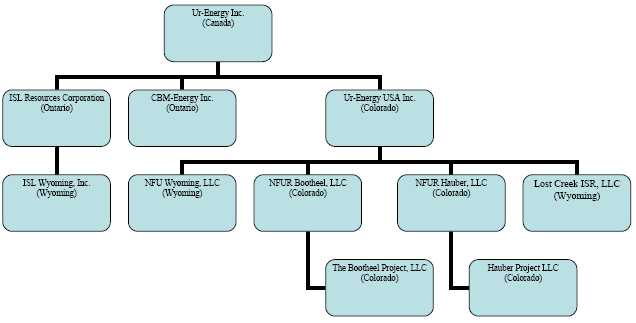
The Corporation has three wholly-owned subsidiaries: Ur-Energy USA Inc. (“Ur-Energy USA”), a company incorporated under the laws of the State of Colorado for the acquisition of properties in the United States; ISL Resources Corporation (“ISL”), a company incorporated under the laws of the Province of Ontario; and CBM-Energy Inc. (“CBM”), a company incorporated under the laws of the Province of Ontario, that is a shell company with no assets or liabilities other than those related to its incorporation.
ISL has one wholly-owned subsidiary, ISL Wyoming, Inc., a company incorporated under the laws of the State of Wyoming.
Ur-Energy USA has four wholly-owned subsidiaries: NFU Wyoming, LLC (“NFU”), a limited liability company formed under the laws of the State of Wyoming to facilitate the Corporation’s acquisition of certain property and assets; NFUR Bootheel, LLC, a limited liability company formed under the laws of the State of Colorado to facilitate the Corporation’s participation in an exploration, mining and development agreement with Target Exploration & Mining Corp.; NFUR Hauber, LLC, a limited liability company formed under the laws of the State of Colorado to facilitate the Corporation’s participation in an exploration, mining and development agreement with Trigon Uranium Corporation; and, Lost Creek ISR, LLC, a limited liability company formed under the laws of the State of Wyoming to hold and operate the Corporation’s Lost Creek property and assets.
NFUR Bootheel has one wholly-owned subsidiary: The Bootheel Project, LLC, a limited liability company formed under the laws of the State of Colorado to hold the Corporation’s Bootheel project and the venture formed with Target Exploration & Mining Corp.
NFUR Hauber has one wholly-owned subsidiary: Hauber Project LLC, a limited liability company formed under the laws of the State of Colorado to hold the Corporation’s Hauber project and the venture formed with Trigon Uranium Corporation.
Both the Bootheel and Hauber projects are described in more detail under the heading “History”.
- 4 -
The principal direct and indirect subsidiaries of the Corporation and the jurisdictions in which they were incorporated or organized are set out below:
- 5 -
GENERAL DEVELOPMENT OF THE BUSINESS
Incorporated on March 22, 2004, Ur-Energy is a development stage junior mining company engaged in the identification, acquisition, evaluation, exploration and development of uranium mineral properties in Canada and the United States. The registered office of the Corporation is in Ottawa, Ontario, Canada and the corporate headquarters is located in Littleton, Colorado, USA. Ur-Energy has also established an operations office in Casper, Wyoming, USA and an exploration office in Brampton, Ontario, Canada.
The Corporation’s current land portfolio includes fourteen properties in Wyoming, USA: eleven are in the Great Divide Basin, two of which (the Lost Soldier property and the Lost Creek property) contain defined resources that the Corporation expects to advance to production. The Corporation’s other Wyoming projects include two properties in the Shirley Basin, one of which is the Bootheel property. The last of the Wyoming properties, is the Kaycee property, located in the Powder River Basin. In South Dakota, USA, the Corporation has acquired certain state mineral leases in Harding and Fall River Counties, known as the Harding and Fall River properties, and the Corporation also has acquired a property in Yuma County, Arizona, USA. The Corporation has three properties in the Northwest Territories, Canada, known as Screech Lake, Eyeberry and Gravel Hill. The Corporation owns the Bugs property in the Kivalliq region of the Baker Lake Basin in Nunavut, Canada and has a royalty interest in two properties known as Dismal Lake West and Mountain Lake in the western Kitikmeot region, Nunavut, Canada. The Corporation had two properties under an option agreement with Titan Uranium Incorporated in Saskatchewan, Canada but this agreement was discontinued in 2008.
History
United States Properties
Background
The Corporation acquired all of the issued and outstanding shares of ISL under the terms of an October 19, 2004 acquisition agreement (the “Initial ISL Agreement”) between the Corporation and ISL. ISL is a junior exploration company which had engaged in uranium exploration in Wyoming. The Initial ISL Agreement was amended and restated by agreements finalized on April 19 and 21, 2005 (the “Amending ISL Agreements”). Under the terms of the Initial ISL Agreement and the Amending ISL Agreements, the aggregate consideration paid to ISL shareholders for the acquisition of ISL was 4,350,000 common shares of the Corporation and 500,000 common share purchase warrants of the Corporation which were exercisable until December 1, 2006.
The acquisition of ISL included an extensive database of over 4,400 drill hole logs, geologic maps, cross sections and reports within the Kaycee area of the Powder River Basin, Wyoming as well as airborne geophysical reports for the Shamrock and Kaycee areas. In addition, the database included over 2,700 drill hole logs, maps, cross sections, reports, feasibility and engineering studies from Conoco’s 1969 through 1986 exploration program in the Southwest Powder River Basin area relating to the Allemand-Ross project.
Data owned by ISL, and its subsidiary, were the basis of the Corporation’s staking program for the Kaycee and Shamrock projects. In late 2004, the Corporation staked 356 unpatented mineral claims at the Shamrock project. In early 2005, the Corporation initially staked 278 unpatented mineral claims in the Kaycee area of the Powder River Basin, Wyoming.
Under a Letter of Intent dated February 3, 2005 (“Dalco LOI”) entered into by the Corporation and Dalco, Inc. (“Dalco”), the Corporation had an option to acquire seven unpatented mineral claims and land records for the property located in the Great Divide Basin, Wyoming, together with exploration records, drill log files and
- 6 -
related data (collectively the “RS Property”). The Corporation paid Dalco US$25,000 on the signing of the Dalco LOI. Pursuant to the Dalco LOI, the Corporation issued 25,000 common shares to Dalco on June 3, 2005 to acquire a 25% interest in the RS Property.
After the 25% interest had been earned, the Dalco LOI was superseded by a formal agreement dated July 20, 2005 among the Corporation, Ur-Energy USA and Dalco. A further 25% interest in the RS Property was acquired in November 2005 by payment of US$50,000 and the issuance of 50,000 common shares and on December 3, 2006 by payment of US$100,000 and the issuance of 100,000 common shares. On November 8, 2007, the Corporation announced the completion of acquisition of 100% ownership of the seven unpatented mineral claims, exploration records and other data related to the RS project by acquiring the final 25% interest by the payment of US$150,000 and the issuance of an additional 150,000 common shares, subject to Dalco retaining a production royalty of 3% of the total gross proceeds received by Ur-Energy USA from U3O8 extracted by processing uranium ore from the seven mineral claims comprising the RS Property. The acquired RS Property included the historic exploration and development database of more than 2,200 drill hole logs and accompanying geologic maps, cross sections and reports. In February 2005, the Corporation staked additional unpatented mineral claims adjacent to the RS Property.
The Corporation, through its wholly-owned subsidiary, Ur-Energy USA, acquired from New Frontiers Uranium, LLC (“New Frontiers”), a Colorado limited liability company, certain of the Wyoming properties comprising the Great Divide Basin and the Shirley Basin projects. Effective June 30, 2005, Ur-Energy USA entered into the Membership Interest Purchase Agreement (“MIPA”) with New Frontiers. Under the terms of the MIPA, the Corporation purchased from New Frontiers all of the issued and outstanding membership interests (the “Membership Interests”) in NFU. Assets acquired from New Frontiers included the extensively explored and drilled Lost Creek and Lost Soldier projects and development database including over 10,000 electric well logs, over 100 geologic reports and over 1,000 geologic and uranium maps covering large areas of Wyoming, Montana and South Dakota.
Under the MIPA, Ur-Energy USA agreed to purchase and New Frontiers agreed to sell the Membership Interests for an aggregate consideration of US$20,000,000. The total amount payable on closing was US$5,000,000. The balance of the acquisition cost was financed by way of a promissory note payable to New Frontiers. In June 2006, the Corporation made the required first anniversary payment. On June 7, 2007, the Corporation announced that it had fully paid the promissory note due to New Frontiers in the amount of US$11,250,000 which allowed the Corporation to save approximately US$3,750,000 in future interest charges. An existing royalty of 1.67% remains in place with respect to future production from 20 Tony claims comprising a portion of the Lost Creek project claims.
In 2005, the Corporation, through NFU, staked 211 new unpatented mineral claims for the Bootheel and Buckpoint projects within the Shirley Basin, Wyoming. These and others subsequently acquired claims were transferred to The Bootheel Project, LLC described under the heading “History – Bootheel Project/Target Exploration & Mining Corp.”.
Lost Creek and Lost Soldier Projects
On August 26, 2005, the Corporation purchased over 4,000 electric drill hole logs with geologic reports and maps related to the Lost Soldier project area from Power Resources, Inc. (“PRI”). The Corporation paid US$400,000 with a 1% royalty on future production.
In early June 2006, the Corporation announced results of two Canadian Securities Administrators’ National Instrument 43-101 (“NI 43-101”) compliant resource estimations that disclose significantly increased resources on its Lost Creek and Lost Soldier properties from the relevant historic resources. In connection with these results, on July 26, 2006, the Corporation announced that it had filed updated technical reports
- 7 -
prepared by C. Stewart Wallis, P. Geo., currently a consultant to Scott Wilson Roscoe Postle Associates Inc., in accordance with NI 43-101 in respect of both its Lost Creek property (the “Technical Report – Lost Creek July 2006”) and Lost Soldier property (the “Technical Report – Lost Soldier July 2006”) in the Great Divide Basin in Wyoming.
In June 2006, the Corporation also announced that the results of leach amenability studies on uranium core samples from the Lost Creek and Lost Soldier properties. These tests were performed by Energy Laboratories Inc. of Casper, Wyoming and will assist the Corporation in determining the possible in-situ leachability of the uranium bearing sandstone and the potential rate of recovery. Earlier NI 43-101 s had been filed with respect to these properties in 2005 in connection with the Corporation’s initial public offering.
On July 10, 2006, the Corporation announced that it had made progress in its comprehensive program to advance engineering, permitting and mine feasibility at its Lost Creek and Lost Soldier properties. The Corporation also announced that the State of Wyoming Department of Environmental Quality (“WDEQ”) approved permits for monitor well locations that will be used for data collection from both deposits. The Wyoming State Engineer’s office has approved permits for the installation of the wells for pump testing and water quality testing. Collection of engineering and hydrologic baseline data from the wells has also commenced on both projects and formed part of the Corporation’s applications for permit to mine.
On September 8, 2006, a Docket Number and a Technical Assignment Control Number were issued by the U.S. Nuclear Regulatory Commission (“NRC”) for licensing actions for the Lost Creek and Lost Soldier projects. On March 19, 2008, the Corporation requested a separate Docket Number and Technical Assignment Control Number for the Lost Soldier project from the NRC, in preparation for a separate license application for the Lost Soldier project.
In April 2007, the Corporation announced a three-rig drilling program at its Lost Creek project for the purposes of installing monitors and pump test wells to obtain baseline and hydrogeologic data for engineering feasibility studies. On September 29, 2007, Ur-Energy announced that it had completed its planned drilling program for 2007 and, based on favourable results and early completion, the Corporation extended its program to include an additional 125 delineation drill holes at the Lost Creek project. Completion of the Phase I and Phase II drilling programs resulted in 58 monitor and pump test wells, two water wells and a total of 195 delineation drill holes.
In late January and early February 2008, the Corporation announced the results of the 2007 drilling program for its Lost Creek project and the results of leach amenability studies on its core samples from the Lost Creek project. Ur-Energy completed an in-house economic analysis on its Lost Creek project and commissioned an independent technical report under NI 43-101 to be prepared by Lyntek Incorporated (“Lyntek”).
On October 30, 2007, Ur-Energy submitted its application to the NRC for a Source Material License for the Lost Creek project. This license is the first stage of obtaining all necessary licenses and permits to enable the Corporation to recover uranium via the in-situ recovery method at Lost Creek. The NRC has indicated that the application review process can take up to 18 months to complete. On February 29, 2008, the Corporation announced it had voluntarily withdrawn its application from the NRC to enable the Corporation to include upgrades to its application related to its operational plan and health physics information and planned to resubmit the application within 30 days. On March 24, 2008, the Corporation announced that it had resubmitted the Source Material License application to the NRC.
On December 20, 2007, the Corporation announced the submission of an Application for In Situ Permit to Mine and an Application for License to Mine to the WDEQ for its Lost Creek project.
- 8 -
United States Exploration Projects
The Corporation’s geologists are conducting an evaluation of the extensive well log and exploration database owned by the Corporation. During 2007, exploration was carried out on five projects: three on wholly-owned projects and two by other companies through exploration, development and operating ventures on Corporation properties. See headings “Bootheel Project / Target Exploration & Mining Corp.” and “Hauber Project /Trigon Uranium Corporation” below.
During the year ended December 31, 2007, approximately 24,000 additional claim acres and approximately 27,000 additional state lease acres of on-trend mineral properties were acquired and added to the Corporation’s United States property portfolio. Total United States landholdings are now approximately 134,000 acres.
On June 19, 2006, the Corporation completed an acquisition of four claim groups in the Great Divide Basin of Wyoming, consisting of a total of 130 unpatented mining claims (approximately 2,700 acres) from John Wells of Wyoming. The Toby property contains an historic resource, not NI 43-101 compliant, of one million pounds of U3O8 and the other properties have potential for future development. Consideration provided was comprised of 250,000 common shares. Subsequently, on September 29, 2006, the Corporation acquired 82 additional unpatented mining claims from John Wells relating to these claim groups. Consideration for this acquisition was US$41,000. Under the terms of the agreements, the Corporation will provide the seller with a 2% royalty on future uranium production from the acquired properties and from a one-mile area of interest surrounding the properties.
Drilling was initiated on the RS project during mid-November 2007. A total of six rotary drilled reconnaissance exploration holes were drilled for a total of 5,530 feet (1,685 meters) before drilling ceased in late December 2007 due to winter weather and ground conditions. The drilling program was intended to test stratigraphic and alteration characteristics of the Battle Spring Formation within a frontier portion of the property. The last two holes drilled were mineralized and exhibited geologic characteristics, indicating that drilling had been progressing in the direction of a potential mineral trend.
The EN project lies approximately five miles east-southeast of the Lost Creek project. The primary goal of the 2007 drilling program was to investigate multiple occurrences of significant uranium mineral intercepts detected at depth in an abandoned oil and gas exploration hole drilled in 1979. A secondary goal was to provide reconnaissance information regarding stratigraphic and alteration characteristics of the Battle Spring Formation to supplement historic drilling data from elsewhere within the property. Drilling was completed in late October 2007. Three rotary drill holes were completed for a total of 8,605 feet (2,623 meters). The results confirmed mineralization in the target zone. The primary targeted mineral intercept was 6.5 feet of 0.10% at 2,200 feet. The same intercept in EN29-1 (50 foot offset) was two feet of 0.078% at 2,214.5 feet (0.02% cutoff). Although the planned drilling program was insufficient to substantiate economic concentrations, multiple, previously undetected, horizons of oxidation and trace mineralization were identified in the new drill holes. This new information is being evaluated within the framework of historic drilling data. Drilling will resume in 2008 and will focus on testing the results of this investigation.
The LC North project lies adjacent to the Lost Creek project. The primary goal of the 2007 drilling program was to investigate numerous occurrences of uranium-bearing intercepts detected by historical exploration drilling by previous operators in the 1970s; and to examine their relationships to the mineralization to be mined at the Lost Creek project. Preliminary evaluation of this historic drilling data indicated the potential for mineral trends in two areas, informally referred to as the East and West areas. A drilling program, consisting of 50 planned exploration holes, was initiated in late October 2007. Drilling was halted in early December 2007 in order to divert the drill rigs to activities at the Lost Creek project. To that point in time, 30 holes were drilled for a total of 29,600 feet (9,022 meters). One hole was abandoned prior to logging due to drilling
- 9 -
problems. Drilling focused on the West area where 25 holes were drilled at variable spacing. Five holes were drilled in the East area. The West area is approximately one mile north of the west-central portion of the Lost Creek mineral trend; and the East area is approximately one mile north of the east-central portion of Lost Creek trend.
The results confirmed mineralization occurring in multiple target horizons, many of which correlate stratigraphically with mineral horizons in the Lost Creek trend. Drilling in this area was at variable and wide spacing and did not allow confirmation of mineral continuity or estimation of resources; the results clearly indicate the potential for extension of the Lost Creek mineral trends into the LC North property, as well as the possibility of previously unidentified mineral horizons. Drilling will be resumed in 2008 and will focus on testing continuity with the Lost Creek mineral trends and defining resource estimates.
During October 2006, the Corporation acquired 79 State of South Dakota Mineral Leases containing approximately 46,363 acres in Harding County, northwest South Dakota. In 2007, the Corporation acquired an additional 65 State of South Dakota Mineral Leases in Harding County, totaling approximately 25,134 acres and two State of South Dakota Mineral Leases in Fall River County, containing approximately 1,240 acres. A detailed geologic evaluation of the project area has commenced. Historic exploration drilling for uranium in this region has been very limited.
In the Colorado Plateau, Arizona, USA, the Corporation staked 34 unpatented mineral claims, totaling 700 acres, in Yuma County.
Bootheel Project / Target Exploration & Mining Corp.
On March 17, 2006, Ur-Energy and Energy Metals Corporation (“Energy Metals”) signed an agreement to complete a land swap enabling each company to consolidate its respective land positions in specific project areas in Wyoming. The parties determined that the consolidation of the property positions would create greater efficiencies in exploration and future mine planning. The Corporation traded its Shamrock properties and Chalk Hills properties for Energy Metals’ properties in the Bootheel project area. Pursuant to the agreement, the Corporation received Energy Metals’ 28 unpatented mineral claims known as the TD group in Albany County, Wyoming. Energy Metals received the Corporation’s 356 unpatented “F” mineral claims located in the southern Great Divide Basin in Carbon and Sweetwater Counties, Wyoming along with two unpatented “Rita” mining claims located in the Shirley Basin in Carbon County, Wyoming. Under the terms of the agreement, Energy Metals and the Corporation have granted one another a ½% royalty on future production of uranium from the properties.
On June 16, 2006, the Corporation entered into a data purchase agreement related to the Bootheel and Buckpoint project areas in the Shirley Basin, Wyoming. The Corporation paid US$90,000 related to the acquisition of this data. The data acquired relates to historic drill hole geophysical logs, lithologic logs, drill hole maps and geologic cross sections, from previous operators and historical feasibility reports. Under the terms of the agreement, the Corporation will provide the seller with a 1% royalty on uranium and associated minerals produced from the property. In July 2006, 36 new mineral claims were acquired by the Corporation to add to the Bootheel project.
During June 2007, the Corporation entered into an Exploration, Development and Mine Operating Agreement with Target Exploration & Mining Corp. and its subsidiary ("Target"). Under the terms of the agreement, the Corporation, through its wholly-owned subsidiary, NFUR Bootheel, LLC, contributed its Bootheel and Buck Point properties to The Bootheel Project, LLC. The properties cover an area of known uranium occurrences within the Shirley Basin in Albany County, Wyoming. The total project covers a defined area of approximately 6,780 acres. The primary goal is to move rapidly to the production of uranium, possibly by the in-situ recovery mining method.
- 10 -
The Bootheel and Buck Point properties contributed by the Corporation are comprised of 269 mining claims and two state leases. Target will contribute US$3,000,000 in exploration expenditures and issue a total of 125,000 common shares of Target to the Corporation over a four year period in order to earn a 75% interest in The Bootheel Project, LLC. Minimum exploration expenditures of US$750,000 are required in each year during the four year earn-in period. During August 2007, the Corporation received the initial installment of 50,000 Target common shares. Target is the manager of the project.
Uranium mineralization was intersected on both properties during the late 1970s and the mineralization has the potential to be recovered by in-situ recovery methods. Uranium was discovered in the Shirley Basin in 1955 and production continued until 1992. Although the majority of commercial production in the Shirley Basin was carried out by conventional mining methods, in-situ recovery methods were tested on several deposits.
Hauber Project / Trigon Uranium Corporation
During June 2007, the Corporation entered into agreements with Trigon Uranium Corporation and its subsidiary ("Trigon"). Under the terms of the agreements, the Corporation, through its wholly-owned subsidiary, NFUR Hauber, LLC, contributed its Hauber property to Hauber Project LLC. The Hauber property is located in Crook County, Wyoming and consists of 205 unpatented lode mining claims and one state uranium lease totaling approximately 5,160 acres. The property is over an area of identified uranium occurrences. Pursuant to the terms of the agreements, Trigon can earn a 50% ownership interest in Hauber Project LLC by contributing a total of US$1,500,000 in exploration expenditures to the project over three years. Minimum exploration expenditures of US$350,000 are required in year one of the earn-in period with US$575,000 required in each of years two and three. Trigon is the manager of the project.
The agreements further provide that after Trigon has earned the 50% ownership interest, Trigon has the option to acquire an additional 1% ownership interest by making an additional payment of US$1,000,000 for project exploration and expenditures. If Trigon does not exercise this option, the Corporation may do so for the same payment contribution. The agreements provided for an environmental due diligence period during which Trigon was to conduct an independent study to confirm that there are no manmade environmental hazards or other environmental liabilities prior to the commencement of the project. During September 2007, Trigon notified the Corporation that pursuant to its environmental due diligence it had satisfied itself of this requirement.
Canadian Properties
Thelon Basin Properties
The Thelon Basin Properties are grass roots projects which the Corporation believes have potential for discovery of high-grade unconformity uranium deposits of the Athabasca style. The claims are located on Crown Lands situated in the Thelon Basin of the Northwest Territories. The Thelon Basin is host to the undeveloped Kikkavik-Andrew Lake and End uranium deposits.
Potential high-grade uranium at the unconformity on the Screech Lake claim group is indicated by high surface radon and radiogenic helium gases in soils and radioactive groundwaters emitted by lake bottom springs. Airborne MEGATEM® surveys and ground electromagnetic surveys confirm a very low resistivity zone underlying the anomalous surface conditions at and above the unconformity contact. This strong basement electromagnetic conductor has been interpreted to be due to clay alteration just above the unconformity.
Since the completion of the technical report dated February 25, 2005, updated June 22, 2005, and October 20, 2005, on Gravel Hill, Screech Lake and Eyeberry Properties together comprising the Thelon Basin Projects
- 11 -
located in the Northwest Territories, Canada prepared by John D. Charlton, P. Geo (the “Technical Report – Thelon Property”), certain components of the recommended work program have been undertaken and/or completed.
In mid 2005, Aurora Geosciences Ltd. completed a ground PROTEM 57 electromagnetic survey and ground magnetic and VLF surveys over parts of the Screech Lake project, and Fugro Airborne Surveys completed a MEGATEM airborne electromagnetic and magnetic survey over the entire Screech Lake project. In addition, the Corporation completed an EIC (electret ion chamber) radon sampling and prospecting exploration program on the Screech Lake project. Condor Consulting completed a processing and analysis of the MEGATEM survey data for the Screech Lake project in April 2006.
In mid 2006, Aurora Geosciences Ltd. completed further ground PROTEM 57, magnetic, and VLF-EM surveys, extending the survey of the Screech Lake area southward and eastward including coverage of the Southeast Anomaly. A ground exploration program was also completed, the principal components of which were ground radon flux monitor (RFM) surveys utilizing EIC radon measurement techniques. Highly anomalous radon concentrations and trends were identified. The coincidence of consistent high to extremely high radon with deep structure and conductivity combine to make the North Screech Radon Trend the primary focus of more advanced exploration on the Screech Lake project.
The Corporation contracted Golder Associates (“Golder”) to facilitate the land use permit application process and to complete an environmental benchmark study at the Screech Lake project. Following community consultations with the Lutsel K’e Dene and the Fort Resolution Dene, the Corporation and Golder re-applied for a Land Use Permit on July 13, 2006 after having withdrawn its initial application. In August 2006, Golder completed an extensive benchmark environmental study and the Corporation conducted a community site visit to the Screech Lake project with representatives of Lutsel K’e. During September 2006, the land use permit application was referred to the Mackenzie Valley Environmental Impact Review Board (“MVEIRB”) for environmental assessment. In January 2007, MVEIRB held hearings on the Screech Lake project at Lutsel K’e. The environmental assessment was completed on February 28, 2007.
On May 9, 2007 the MVEIRB recommended to the Minister of Indian and Northern Affairs Canada (the “Minister”) that the Corporation’s application to conduct an exploratory drilling program be rejected pursuant to section 128(1)(d) of the Mackenzie Valley Resource Management Act and the Minister adopted the recommendation of the MVEIRB in October 2007. The Minister confirmed that the decision does not affect the legal standing of the Corporation’s mineral claims on the Screech Lake project.
Subsequently, at the invitation of The Honourable Charles Strahl, Minister of Indian and Northern Development, Ur-Energy met with the Honourable Minister to discuss its Screech Lake project and understand how the Corporation might proceed with exploration in respect of its Screech Lake project. Ur-Energy has engaged in discussions and review of the Screech Lake project with the Akaitcho Dene First Nations and the Northwest Territories Mineral Exploration Industry to see what options are available to move forward with the exploration program.
Bugs Property, Baker Lake Basin
On September 7, 2006, the Corporation entered into an option agreement to acquire the Bugs property in Nunavut, Canada. The Corporation has earned a 100% interest in the property by issuing a total of 85,000 common shares to the vendor. Upon signing, 10,000 common shares were issued to obtain an initial 12% interest in the property. On the first anniversary in September 2007, an additional 25,000 common shares were issued for an additional 30% interest. During December 2007, the final installment of 50,000 common shares was issued for the final 58% interest. The vendor retains a 2% net smelter royalty, of which 1% is
- 12 -
subject to a buyout for $1,000,000. The Bugs property consists of 11 contiguous mineral claims in the Kivalliq region of the Baker Lake Basin, Nunavut.
During the summer of 2007, the Corporation re-sampled the high-grade boulder area identified by historic Cominco work conducted during the 1970s. New assays include values as high as 4.7% and 6.0% U3O8. Exploration drilling by Cominco in 1979 was not successful in discovering bedrock sources of this high-grade mineralization. The 1970s drilling and sampling of several bostonite occurrences averaged 250 ppm uranium over significant widths. Two of the larger bostonite intrusions (Shrike and Gamma) were prospected for strike lengths of 800 meters to 1 kilometer, respectively.
In 2006, a fixed wing aeromagnetic and radiometric survey was flown over the entire property by Tundra Airborne Surveys. The data from this survey have been reprocessed using FastMag 3D(TM) normalized sections. Interpretation of airborne magnetic and radiometric surveys resulted in the selection of seven targets based upon structural offset and dilation features in combination with magnetite depletion. Only one of the seven targets was examined in 2007; the remainder will be prospected and surveyed for their radon signatures in 2008. In 2007, RadonEx Ltd. EIC radon surveys were successful in outlining poorly exposed bostonite occurrences over several kilometers in length. In addition, the radon surveys located an area of extremely high radon flux which is interpreted by the Corporation to indicate a concentration of hydrothermal uranium mineralization – the Lowkey Lake Zone (“LLZ”).
In 2008, it is anticipated that a 2,500 meter drill program will be carried out as well as additional radon testing and prospecting. Initial drilling will concentrate on the LLZ. The LLZ occurs at the intersection of the basal tuffs of the Christopher Island Formation continental volcanics with a younger syenite intrusion. High-grade uranium mineralization (individual boulders assaying over 6% U3O8) is associated with the basal tuff horizons along strike to the east of the LLZ. A pronounced linear zone of magnetic depletion and evidence of intense hydrothermal activity coincide with the LLZ.
The 2007 radon survey has also indicated a bedrock source of one of the high-grade historic Cominco boulder occurrences associated with hydrothermal breccias - BA Showing (individual boulders assaying up to 0.55% U3O8). This mineralization is slated for detailed radon survey and subsequent drill-testing in 2008. In addition drill testing of the Gamma bostonite dyke is anticipated. Historic prospecting indicates dimensions of the Gamma Dyke to be up to one kilometer in length by up to 100 meters in width. The extensive, intrusive Bugs bostonites, including Gamma, return consistent grades of between 200 and 400 ppm uranium and high thorium values ranging from 700 ppm to 1,200 ppm. This type of mineralization represents low-grade, bulk tonnage potential. Pending ground localization and additional drilling is planned to test targets selected from the interpretation of the airborne radiometric and magnetic survey.
Hornby Bay Properties
On July 31, 2006, the Corporation completed a definitive agreement with Triex Minerals Corporation (“Triex”) with respect to its Mountain Lake and Dismal Lake West properties. The Mountain Lake property comprises 41 claims and the Dismal Lake West property comprises 17 claims. Pursuant to the option agreement, Triex made a $25,000 cash payment upon execution of the agreement and spent $200,000 on exploration of the properties by September 22, 2006. In order to exercise the option to obtain a 100% interest in the properties, Triex was to incur a further $500,000 in exploration spending by September 30, 2007. The Corporation received notice from Triex during October 2007 that the expenditure requirements had been met. The Corporation retains a 5% net smelter return royalty interest in the properties with Triex having the right to purchase fractional interests for up to an aggregate of 2.5% of the royalty for $5,000,000.
Triex continues to conduct exploration work on the properties and announced on January 24, 2008 that a $3,000,000 budget for 2008 work programs for their Hornby Bay properties has been formally approved. The
- 13 -
program includes 5,000 meters of diamond drilling in eighteen holes to evaluate untested targets and will also include a continuation of resistivity surveys. Construction of an ice air strip, and re-opening of the Kirwan Lake camp are scheduled for early-mid April, with drilling to start in late April.
R-Seven and Rook I Properties, Athabasca Basin
During June 2007, the Corporation announced it had signed a letter of intent with Titan Uranium Incorporated (“Titan”) whereby the Corporation could earn up to an undivided 51% working interest in Titan's R-Seven and Rook I properties by funding $9,000,000 in exploration programs managed by Titan over a 4-year earn in period. Drilling on the property began in early July 2007 with a first year expenditure commitment of $2,000,000. A definitive option agreement was completed during August 2007.
The option agreement called for annual expenditures of $2,000,000 in each of the first three years with a further $3,000,000 in year four. Vesting of a 25% working interest was to be at the Corporation’s election after the expenditure of $4,000,000 in the second year of the agreement. Upon the expenditure of an additional $2,000,000 in year three, the Corporation was to be eligible to vest a further 10% working interest. The remaining 16% working interest was to vest with the expenditure of $3,000,000 in year four. Upon completion of the earn-in phase, the Corporation and Titan were to proceed as joint venture partners with the Corporation becoming project operator.
The R-Seven and Rook I properties include 17 mineral claims totaling 75,698 hectares (187,053 acres). The claims are located in the southwestern portion of Saskatchewan's Athabasca Basin.
Titan commenced drilling on the properties as part of a 2007 exploration program budget of $2,000,000. The program included ground geophysical surveying and approximately 5,000 meters of drilling. The drill targets were strong basement electromagnetic conductors defined by airborne and ground geophysical surveys that were completed in 2005 through 2007.
Management of the Corporation has decided not to proceed with funding of any additional exploration on the Titan properties in favour of additional exploration on properties wholly-owned by the Corporation.
Board of Directors and Management Changes
On January 12, 2006, the Corporation announced that Mr. Robin Dow resigned as Chairman, Chief Executive Officer and as a director of the Corporation. Also Mr. Paul Pitman resigned as President of the Corporation and was appointed as Vice President, Canadian Exploration. Mr. W. William Boberg was appointed President and Acting Chief Executive Officer and a director of the Corporation. Mr. Jeffrey Klenda was appointed Chair of the Board of Directors at that time. On May 29, 2006, the Corporation announced that Mr. W. William Boberg was confirmed as President and Chief Executive Officer of the Corporation.
On March 24, 2006, Mr. Robert Boaz was appointed as a director of the Corporation.
On February 19, 2007, the Corporation appointed Mr. Wayne Heili as Vice President, Mining & Engineering. Mr. Heili will head up the Casper, Wyoming production office and engineering team. Mr. Heili will be responsible for directing the completion of the mining feasibility studies and the development of the Lost Creek and Lost Soldier projects.
Mr. Paul Pitman and Mr. Eric Craigie did not stand for re-election as directors of the Corporation at the Annual and Special Meeting of Shareholders held on May 18, 2007.
- 14 -
On May 22, 2007, Ur-Energy announced the appointment of Mr. Roger Smith as Chief Financial Officer, replacing Mr. John McNeice who remains as a consultant to the Corporation. Mr. Paul G. Goss was also named as General Counsel and Corporate Secretary.
On July 22, 2007, Mr. Thomas Parker was appointed as a director of the Corporation. Mr. Parker replaced Mr. Gary Huber who was appointed as a director of the Corporation on January 3, 2007 and resigned on July 22, 2007.
Financing and U.S. Registration
On November 29, 2005, the Corporation completed its initial public offering and commenced trading on the Toronto Stock Exchange. The initial public offering consisted of 8,000,000 common shares at a price of $1.25 per common share resulting in gross proceeds to the Corporation of $10,000,000. Ur-Energy engaged a syndicate of agents led by Raymond James Ltd., and including Canaccord Capital Corporation and Haywood Securities Inc., in respect of the offering.
On August 2, 2006, the Corporation announced the closing of a non-brokered private placement of flow-through common shares. The financing comprised a total of 182,000 flow-through common shares at a price of $2.75 per share. Total gross proceeds to Ur-Energy were $500,500.
On August 30, 2006, the Corporation announced it had completed a common share bought deal. A syndicate of underwriters purchased, on a bought deal basis, 7,500,000 common shares of Ur-Energy, at a price of $2.20 per share, for gross proceeds of $16,500,000, and also exercised in full an over-allotment option to purchase an additional 1,022,727 common shares at the same price for additional proceeds of approximately $2,250,000. Total gross proceeds to Ur-Energy were $18,750,000.
On December 14, 2006, the Corporation announced the closing of a flow-through common share private placement financing. The private placement comprised 500,000 common shares of the Corporation issued on a flow-through basis at a price of $5.00 per share for aggregate gross proceeds of $2,500,000.
On May 10, 2007, the Corporation announced it had completed a common share bought deal. A syndicate of underwriters purchased, on a bought deal basis, 15,158,000 common shares of Ur-Energy, at a price of $4.75 per share, for gross proceeds of $72,000,500, and also exercised in full an over-allotment option to purchase an additional 2,273,000 common shares at the same price for additional proceeds of $10,796,750. Total gross proceeds to Ur-Energy were $82,797,250.
On January 7, 2008, the Corporation announced that it had filed a Form 40-F with the SEC to register its common shares under Section 12(b) of the U.S. Securities Exchange Act of 1934, as amended. Ur-Energy has filed an application to list its common shares with the American Stock Exchange, LLC. A listing is not guaranteed and is subject to satisfying all listing and other criteria.
On March 26, 2008, the Corporation announced the closing of a non-brokered private placement of flow-through common shares. The financing comprised a total of 1,000,000 flow-through common shares at a price of $2.75 per share. Total gross proceeds to Ur-Energy were $2,750,000.
- 15 -
BUSINESS OF UR-ENERGY
The Corporation is a uranium exploration and development company currently in the process of completing mine planning and permitting activities to bring its Lost Creek Wyoming uranium deposit into production. Ur-Energy engages in the identification, acquisition, evaluation, exploration and development of uranium properties in both Canada and the United States.
During 2007, the Corporation drilled a total of 308 drill holes for a total of 64,193 meters (210,626 feet) as well as completing significant field mapping and sampling on projects in Canada and the United States. A total of 255 holes for 47,675 meters (156,422 feet) were drilled on the Lost Creek project to advance the project toward production. Additionally, 39 drill holes for 13,300 meters (43,745 feet) were drilled on exploration projects in the Great Divide Basin of Wyoming. Advances were made in developing a stronger geologic framework for understanding the geologic structure and stratigraphy of the Great Divide Basin and how it applies to the Lost Creek deposit and other projects within the Great Divide Basin. In 2007, the Corporation increased its United States land holdings by 51,000 acres. In Canada, a major field mapping and sampling program was completed on the Bugs project. The Corporation also funded drilling of 14 drill holes for 3,188 meters (10,459 feet) as the initial cost of an option agreement with Titan on its Rook I and R-Seven properties; however, this option agreement was discontinued in early 2008.
Ur-Energy completed approximately $82,700,000 bought-deal financing in May 2007 and became debt-free in June 2007 with the payment of the New Frontiers obligation. During 2007, Ur-Energy made key additions to its management team and added numerous personnel to its experienced work-force.
The Corporation is actively pursuing future growth opportunities by evaluating the acquisition of exploration, development or production assets as well as considering joint venture projects for existing Corporation properties. At any given time, discussions and activities can be in process on a number of initiatives, each at different stages of development. Although the Corporation may from time to time be a party to a number of letters of intent in respect of certain joint ventures opportunities and other acquisitions, the Corporation currently does not have any binding agreements or binding commitments to enter into any such transactions. There is no assurance that any potential transaction will be successfully completed.
United States - Wyoming
Lost Creek Project
Ur-Energy’s key priority is to advance its Lost Creek project (located in the Great Divide Basin) into production while continuing engineering, geologic and environmental studies at its Lost Soldier project (also located in the Great Divide Basin) in preparation for advancing it to production following Lost Creek going into production. Achievement of these overall objectives depends upon the successful completion of various milestones.
The Lost Creek uranium deposit is located four miles north of Rio Tinto's Sweetwater mill in the Great Divide Basin, Wyoming. The deposit is approximately three miles (4.8 kilometers) long and the mineralization occurs in four main sandstone horizons between 315 feet (96 meters) and 700 feet (213 meters) in depth. NI 43-101 compliant resources (Technical Report – Lost Creek July 2006) for Lost Creek are 9.8 million pounds of U3O8 at 0.058% as an indicated resource and an additional 1.1 million pounds of U3O8 at 0.076% as an inferred resource. In 2006, 17 cased monitoring and pump test wells were completed on the property, and the initial testing was completed successfully.
- 16 -
Significant drilling was conducted during the second and third quarters of 2007 and was completed during mid-September 2007. Up to four drill rigs operated to allow for completion of the following work on the project:
The drilling program was subsequently expanded with the addition of 125 delineation drill holes. The goal of these additional holes was to provide data for detailed mapping and definition of the resources which will be included in the first mine production unit in preparation for the design of the perimeter monitor well ring. The 2007 drilling program was concluded in early December 2007.
Completion of these phases of the drilling program resulted in 58 monitor and pump test wells, two water wells and a total of 195 delineation drill holes. This enabled the Corporation to obtain additional baseline and hydrogeologic data within the first mine unit area for engineering assessments for the WDEQ Permit to Mine application and for the NRC Source Material License application. In addition, six condemnation holes were drilled to make certain the potential target plant location was not over any part of the orebody.
Mineralized intercepts in the 2007 drilling program continue to indicate that the mineralization at Lost Creek is commonly thicker than average mineralized roll fronts in the Great Divide Basin. Examples are LC45 in the HJ sand which was 27 feet (8.2 meters) thick at a grade of 0.121% U3O8 and LC49 in the KM sand which was 25 feet (7.6 meters) thick at a grade of 0.064% U3O8.
During early 2008, an in-house economic analysis on the Lost Creek project was completed by the Corporation’s engineering team. An independent technical report under NI 43-101 is being prepared by Lyntek related to the economic analysis of the potential viability of the mineral resources on the Lost Creek project.
On October 30, 2007, the Corporation submitted its Application to the NRC for a Source Material License for the Lost Creek project. This license is the first stage of obtaining all necessary licenses and permits to enable the Corporation to recover uranium via in-situ recovery method at the Lost Creek project. The collection and compilation of the extensive environmental background data for the application have taken more than two years. The NRC has indicated that the application review process can take up to 18 months to complete. On February 29, 2008, the Corporation announced it had voluntarily requested that the NRC application for its Lost Creek project be withdrawn to enable the Corporation to include upgrades to its application with respect to the project's operational plan and other advances in the health physics information and analyses. On March 24, 2008, the Corporation announced that it had re-submitted the Source Material License Application to the NRC.
During December 2007, the Corporation submitted the Lost Creek Mine Permit Application to the WDEQ. Individual mine unit applications for each well field will be submitted, starting in 2008, to cover each mine unit or well field that will be produced on the Lost Creek project.
Lost Soldier Project
The Lost Soldier project is located approximately 14 miles (22.5 kilometers) to the northeast of the Lost Creek project. The property has over 3,700 historic drill holes defining 14 mineralized sandstone units. NI 43-
- 17 -
101 compliant resources (Technical Report – Lost Soldier July 2006) for Lost Soldier are 5.0 million pounds of U3O8 at 0.064% as a measured resource, 7.2 million pounds of U3O8 at 0.065% as an indicated resource and 1.8 million pounds of U3O8 at 0.055% as an inferred resource.
All environmental baseline studies have been completed, with baseline groundwater and meteorological data collection continuing. In early 2008, the Corporation’s engineering staff commenced detailed engineering evaluations and studies of the Lost Soldier property for in-situproduction planning and inclusion in the permitting process.
A scoping study is being finalized by Pincock, Allen & Holt. This scoping study is for in-house engineering studies only and is not intended to be NI 43-101 compliant. This scoping study will include an evaluation of the minability of additional shallow uranium resources which are above the water table and are not accessible by in-situ recovery methods. These shallow resources were not included in the Corporation’s NI 43-101 compliant resource base for the Lost Soldier project.
On March 19, 2008, the Corporation requested a separate Docket Number and Technical Assignment Control Number for the Lost Soldier project from the NRC, in preparation for a separate license application for the Lost Soldier project.
RISK FACTORS
The following are the principal risk factors relating to Ur-Energy and its business:
Exploration and Development Stage Corporation
The Corporation is engaged in the business of acquiring and exploring mineral properties in the hope of locating economic deposits of minerals. The Corporation’s property interests are in the exploration and development stage only. Accordingly, there is little likelihood that the Corporation will realize profits in the short to medium term. Any profitability in the future from the Corporation’s business will be dependent upon development of an economic deposit of minerals and further exploration and development of other economic deposits of minerals, each of which is subject to numerous risk factors. Further, there can be no assurance, even when an economic deposit of minerals is located, that any of the Corporation's property interests can be commercially mined. The exploration and development of mineral deposits involve a high degree of financial risk over a significant period of time which a combination of careful evaluation, experience and knowledge of management may not eliminate. While discovery of additional ore-bearing structures may result in substantial rewards, few properties which are explored are ultimately developed into producing mines. Major expenses may be required to establish reserves by drilling and to construct mining and processing facilities at a particular site. It is impossible to ensure that the current exploration programs of the Corporation will result in profitable commercial mining operations. The profitability of the Corporation's operations will be, in part, directly related to the cost and success of its exploration and development programs which may be affected by a number of factors. Substantial expenditures are required to establish reserves which are sufficient to commercially mine some of the Corporation's properties and to construct, complete and install mining and processing facilities in those properties that are actually mined and developed.
Uranium Prices
The price of uranium fluctuates. The future direction of the price of uranium will depend on numerous factors beyond the Corporation’s control including international, economic and political trends, expectations of inflation, currency exchange fluctuations, interest rates, global or regional consumption patterns, speculative activities and increased production due to new extraction developments and improved extraction and production methods. The effect of these factors on the price of uranium, and therefore on the economic
- 18 -
viability of the Corporation’s properties, cannot accurately be predicted. As the Corporation is only at the exploration and development stage, it is not yet possible for it to adopt specific strategies for controlling the impact of fluctuations in the price of uranium.
Uranium Market Factors
The marketability of uranium is subject to numerous factors beyond the control of the Corporation. The price of uranium may experience volatile and significant price movements over short periods of time. Factors affecting price include demand for nuclear power, political and economic conditions in uranium producing and consuming countries, reprocessing of spent fuel and the re-enrichment of depleted uranium tails or waste, sales of excess civilian and military inventories (including from the dismantling of nuclear weapons) by governments and industry participants and production levels and costs of production in geographical areas such as Russia, Africa and Australia.
No Current Mineral Reserves
Calculations of mineral resources and metal recovery are only estimates, and there can be no assurance about the quantity and grade of minerals until reserves or resources are actually mined. While we have mineral resources, we currently do not have any mineral reserves. Until reserves or resources are actually mined and processed, the quantity of reserves or resources and grades must be considered as estimates only. In addition, the quantity of reserves or resources may vary depending on commodity prices. Any material change in the quantity of resources, grade or stripping ratio may affect the economic viability of our properties.
Management, Dependence on Key Personnel, Contractors and Service Providers
Shareholders will be relying on the good faith, experience and judgment of the Corporation’s management and advisors in supervising and providing for the effective management of the business and the operations of the Corporation and in selecting and developing new investment and expansion opportunities. The Corporation may need to recruit additional qualified employees, contractors and service providers to supplement existing management. The Corporation will be dependent on a relatively small number of key persons, the loss of any one of whom could have an adverse effect on the Corporation’s business and operations.
Industry Conditions
The exploration for, and development of, mineral deposits involves significant risks which a combination of careful evaluation, experience and knowledge may not eliminate. While the discovery of an ore body may result in substantial rewards, few properties which are explored are ultimately developed into producing mines. Major expenses may be required to establish ore reserves, to develop metallurgical processes and to construct mining and processing facilities at a particular site. It is impossible to ensure that the current exploration and development programs planned by the Corporation will result in a profitable commercial operation.
Whether a mineral deposit will be commercially viable depends on a number of factors, some of which are the particular attributes of the deposit, such as size, grade and proximity to infrastructure, as well as uranium prices which are highly cyclical and government regulations, including regulations relating to prices, taxes, royalties, land tenure, land use, importing and exporting of uranium and environmental protection. The exact effect of these factors cannot be accurately predicted, but the combination of these factors may result in the Corporation not receiving an adequate return on invested capital.
Mining operations generally involve a high degree of risk. The Corporation's operations will be subject to all the hazards and risks normally encountered in the exploration and development of uranium, including unusual
- 19 -
and unexpected geology formations, flooding and other conditions involved in the drilling and removal of material, any of which could result in damage to, or destruction of, mines and other producing facilities, damage to life or property, environmental damage and possible legal liability.
Value of the Common Shares
The value of the Corporation’s common shares could be subject to significant fluctuations in response to variations in quarterly and yearly operating results, the success of the Corporation's business strategy, competition or other applicable regulations which may affect the business of the Corporation and other factors.
Competition
The international uranium industry is highly competitive. The Corporation's activities are directed towards the search, evaluation and development of uranium deposits. There is no certainty that the expenditures to be made by the Corporation will result in discoveries of commercial quantities of uranium deposits. There is aggressive competition within the mining industry for the discovery and acquisition of properties considered to have commercial potential. The Corporation will compete with other interests, many of which have greater financial resources than it will have, for the opportunity to participate in promising projects. Significant capital investment is required to achieve commercial production from successful exploration and development efforts.
Nuclear energy competes with other sources of energy, including oil, natural gas, coal and hydro-electricity. These other energy sources are to some extent interchangeable with nuclear energy, particularly over the longer term. Lower prices of oil, natural gas, coal and hydro-electricity may result in lower demand for uranium concentrate and uranium conversion services. Furthermore, the growth of the uranium and nuclear power industry beyond its current level will depend upon continued and increased acceptance of nuclear technology as a means of generating electricity. Because of unique political, technological and environmental factors that affect the nuclear industry, the industry is subject to public opinion risks which could have an adverse impact on the demand for nuclear power and increase the regulation of the nuclear power industry.
Additional Funding
Additional funds may be required for future exploration and development. The source of future funds available to the Corporation is through the sale of additional equity capital, proceeds from the exercise of convertible equity instruments outstanding or borrowing of funds. There is no assurance that such funding will be available to the Corporation. Furthermore, even if such financing is successfully completed, there can be no assurance that it will be obtained on terms favourable to the Corporation or will provide the Corporation with sufficient funds to meet its objectives, which may adversely affect the Corporation's business and financial position. In addition, any future equity financings by the Corporation may result in substantial dilution for existing shareholders of the Corporation.
Lack of Earnings and Dividend Record
The Corporation has no earnings or dividend record. It has not paid dividends on its common shares since incorporation and does not anticipate doing so in the foreseeable future. Payments of any dividends will be at the discretion of the board of directors of the Corporation after taking into account many factors, including our financial condition and current and anticipated cash needs.
- 20 -
The Impact of Hedging Activities on Profitability
Although the Corporation has no present intention to do so, it may hedge a portion of its future uranium production to protect it against low uranium prices and/or to satisfy covenants required to obtain project financings. Hedging activities are intended to protect the Corporation from the fluctuations of the price of uranium and to minimize the effect of declines in uranium prices on results of operations for a period of time. Although hedging activities may protect a company against low uranium prices, they may also limit the price that can be realized on uranium that is subject to forward sales and call options where the market price of uranium exceeds the uranium price in a forward sale or call option contract.
Environmental Risk and Compliance with Environmental Regulations which are Increasing and Costly
Environmental legislation is evolving in a manner which will require stricter standards and enforcement, increased fines and penalties for non-compliance, more stringent environmental assessments of proposed projects and a heightened degree of responsibility for companies and their officers, directors and employees. Compliance with environmental quality requirements and reclamation laws imposed by federal, state, provincial, and local governmental authorities may require significant capital outlays, materially affect the economics of a given property, cause material changes or delays in our intended activities, and expose us to litigation. These authorities may require us to prepare and present data pertaining to the effect or impact that any proposed exploration for or production of minerals may have upon the environment. The requirements imposed by any such authorities may be costly, time consuming, and may delay operations. Future legislation and regulations designed to protect the environment, as well as future interpretations of existing laws and regulations, may require substantial increases in equipment and operating costs and delays, interruptions, or a termination of operations. We cannot accurately predict or estimate the impact of any such future laws or regulations, or future interpretations of existing laws and regulations, on our operations. Historic mining activities have occurred on certain of our properties. If such historic activities have resulted in releases or threatened releases of regulated substances to the environment, potential for liability may exist under federal or state remediation statutes.
Title to Property May be Uncertain
Although the Corporation has obtained title opinions with respect to certain of its properties and has taken reasonable measures to ensure proper title to its properties, there is no guarantee that title to any of its properties will not be challenged or impugned. Third parties may have valid claims underlying portions of the Corporation's interests. The Corporation’s mineral properties in the United States consist of private mineral rights, leases covering state and private lands, leases of patented mining claims, and unpatented mining claims. Many of our mining properties in the United States are unpatented mining claims to which the Corporation has only possessory title. Because title to unpatented mining claims is subject to inherent uncertainties, it is difficult to determine conclusively ownership of such claims. These uncertainties relate to such things as sufficiency of mineral discovery, proper posting and marking of boundaries and possible conflicts with other claims not determinable from descriptions of record. The present status of the Corporation’s unpatented mining claims located on public lands allows the Corporation the exclusive right to mine and remove valuable minerals, such as precious and base metals. The Corporation is allowed to use the surface of the public lands solely for purposes related to mining and processing the mineral-bearing ores. However, legal ownership of the land remains with the United States. The Corporation remains at risk that the mining claims may be forfeited either to the United States or to rival private claimants due to failure to comply with statutory requirements. The Corporation has or will take all curative measures to ensure proper title to its properties where necessary and where possible.
Land Claims
Certain properties in which the Corporation has an interest or an option to acquire an interest may be the
- 21 -
subject of aboriginal land claims.
Uninsured Hazards
The Corporation currently carries insurance coverage for general liability, directors’ and officers’ liability and other matters. The Corporation intends to carry insurance to protect against certain risks in such amounts as it considers adequate. The nature of the risks the Corporation faces in the conduct of its operations is such that liabilities could exceed policy limits in any insurance policy or could be excluded from coverage under an insurance policy. The potential costs that could be associated with any liabilities not covered by insurance or in excess of insurance coverage or compliance with applicable laws and regulations may cause substantial delays and require significant capital outlays, adversely affecting the Corporation’s business and financial position.
Conflicts of Interest
Certain directors of the Corporation also serve as directors and officers of other companies involved in natural resource exploration, development and production. Consequently, there exists the possibility that such directors will be in a position of conflict of interest. Any decision made by such directors involving the Corporation will be made in accordance with their duties and obligations to deal fairly and in good faith with the Corporation and such other companies. In addition, such directors will declare, and refrain from voting on, any matter in which such directors may have a material interest.
Permits, Licences and Approvals
The operations of the Corporation may require licences and permits from various governmental authorities. The Corporation believes it holds or is in the process of obtaining all necessary licences and permits to carry on the activities which it is currently conducting under applicable laws and regulations. Such licences and permits are subject to changes in regulations and in various operating circumstances. There can be no guarantee that the Corporation will be able to obtain all necessary licences and permits that may be required to maintain its exploration and mining activities including constructing mines or milling facilities and commencing operations of any of their exploration properties. In addition, if the Corporation proceeds to production on any exploration property, it must obtain and comply with permits and licences which may contain specific conditions concerning operating procedures, water use, the discharge of various materials into or on land, air or water, waste disposal, spills, environmental studies, abandonment and restoration plans and financial assurances. There can be no assurance that the Corporation will be able to obtain such permits and licences or that it will be able to comply with any such conditions.
Regulatory Matters
The Corporation's business is subject to various federal, state, provincial and local laws governing prospecting and development, taxes, labour standards and occupational health, mine safety, toxic substances, environmental protection and other matters. Exploration and development are also subject to various federal, state, provincial and local laws and regulations relating to the protection of the environment. These laws impose high standards on the mining industry to monitor the discharge of waste water and report the results of such monitoring to regulatory authorities, to reduce or eliminate certain effects on or into land, water or air, to progressively rehabilitate mine properties, to manage hazardous wastes and materials and to reduce the risk of worker accidents. A violation of these laws may result in the imposition of substantial fines and other penalties. There can be no assurance that the Corporation will be able to meet all the regulatory requirements in a timely manner or without significant expense or that the regulatory requirements will not change to prohibit the Corporation from proceeding with certain exploration and development.
Members of the United States Congress have repeatedly introduced bills which would supplant or alter the
- 22 -
provisions of the United States Mining Law of 1872, as amended. If enacted, such legislation could change the cost of holding unpatented mining claims and could significantly impact the Corporation’s ability to develop mineralized material on unpatented mining claims. Such bills have proposed, among other things, to either eliminate or greatly limit the right to a mineral patent and to impose a federal royalty on production from unpatented mining claims. Although it is impossible to predict at this point what any legislated royalties might be, enactment could adversely affect the potential for development of such mining claims and the economics of existing operating mines on federal unpatented mining claims. Passage of such legislation could adversely affect our financial performance.
Deregulation of the Electrical Utility Industry
The Corporation’s future prospects are tied directly to the electrical utility industry worldwide. Deregulation of the utility industry, particularly in the United States and Europe, is expected to affect the market for nuclear and other fuels for years to come, and may result in a wide range of outcomes including the expansion or the premature shutdown of nuclear reactors.
Potential Adverse U.S. Federal Income Tax Consequences
A non-U.S. corporation generally will be considered a “passive foreign investment company”) (a “PFIC”) as such term in defined in the U.S. Internal Revenue Code of 1986, as amended (the “Code”) for any taxable year if either (1) at least 75% of its gross income is passive income or (2) at least 50% of the value of its assets is attributable to assets that produce or are held for the production of passive income. If the Corporation were treated as a PFIC for any taxable year in which a U.S. holder held the Corporation’s shares, certain adverse consequences could apply, including a material increase in the amount of tax that the U.S. holder would owe, an imposition of tax earlier than would otherwise be imposed, interest charges and additional tax form filing requirements. As described below, the adverse tax consequences may be diminished if the U.S. holder of the shares of PFIC makes an election with respect to marketable PFIC shares to mark such shares to market each year taking the gain into account as ordinary income (a “mark-to-market” election), or makes a timely qualified electing fund (a “QEF” election), pursuant to which such shareholder must report on a current basis his or her shares of the PFIC’s ordinary earning and net capital gain for any taxable year in which the Registrant is a PFIC, whether or not the PFIC distributes those earnings.
Mark-to-Market Election. In general, U.S. holders who hold, actually or constructively, marketable stock (as specifically defined in the rules and regulations promulgated under the Code) of a PFIC may annually elect to mark such stock to the market. If this election is made, the U.S. holder is taxed annually on the increase in value of the PFIC shares. This election generally is available only to U.S. investors in foreign companies that are regularly traded on a U.S. stock exchange (or on certain approved non-U.S. stock exchanges)
QEF Election. In general, a U.S. holder who makes a timely QEF election with respect to a PFIC’s shares (generally, in the first taxable year in which the U.S. holder holds a PFIC’s shares) will be subject to current U.S. federal income tax on a current basis on a pro-rata share of the ordinary income and long-term net capital gain realized by the PFIC. Generally, shareholders do not make a QEF election unless they have sufficient information to determine their proportionate shares of a corporation’s net capital gain and ordinary earnings. We have not calculated these amounts for any shareholder and do not anticipate making these calculations in the foreseeable future.
The determination of whether a corporation is a PFIC involves the application of complex tax rules. The Corporation has not made a conclusive determination as to whether it has been in prior tax years or is currently a PFIC. The Corporation could have qualified as a PFIC for past tax years and may qualify as a PFIC currently or in future tax years. However, no assurance can be given as to such status for prior tax years and for the current tax year. U.S. holders of Corporation’s shares are urged to consult their own tax advisors regarding the application of U.S. income tax rules.
- 23 -
Foreign Private Issuer Status
Ur-Energy is a “foreign private issuer,” as such term is defined in Rule 405 under the U.S. Securities Act of 1933, as amended, and, therefore, it is not required to comply with all the periodic disclosure and current reporting requirements of the U.S. Securities Exchange Act of 1934, as amended, and related rules and regulations. In order for the Corporation to maintain its current status as a foreign private issuer, a majority of its common shares must be either directly or indirectly owned of record by non-residents of the U.S., as it does not currently satisfy any of the additional requirements necessary to preserve this status.
The Corporation may in the future lose its foreign private issuer status if a majority of its shares are owned of record by residents of the U.S. and it continues to fail to meet the additional requirements necessary to avoid loss of foreign private issuer status. The regulatory and compliance costs to the Registrant under U.S. securities laws as a U.S. domestic issuer may be significantly more than the costs it incurs as a Canadian foreign private issuer eligible to use the Multi-Jurisdictional Disclosure System (“MJDS”). If it is not a foreign private issuer, it would not be eligible to use the MJDS or other foreign issuer forms and would be required to file periodic and current reports and registration statements on U.S. domestic issuer forms with the SEC, which are more detailed and extensive than the forms available to a foreign private issuer. The Corporation may also be required to prepare its financial statements in accordance with U.S. generally accepted accounting principles (“GAAP”). In addition, the Corporation may lose the ability to rely upon exemptions from certain corporate governance requirements on U.S. stock exchanges that are available to foreign private issuers. Further, if the Corporation engages in capital raising activities through private placements after losing its foreign private issuer status, there is a higher likelihood that investors may require the Corporation to file resale registration statements with the SEC a condition to any such financing.
DIVIDENDS
As of the date hereof, the Corporation has not paid any dividends on its outstanding common shares and has no current intention to declare dividends on its common shares in the foreseeable future. Any decision to pay dividends on its common shares in the future will be dependent upon the financial requirements of the Corporation to finance future growth, the general financial condition of the Corporation and other factors which the board of directors of the Corporation may consider appropriate in the circumstances.
CAPITAL STRUCTURE OF THE COMPANY
The authorized capital of the Corporation consists of an unlimited number of common shares and an unlimited number of Class A Preference Shares. As of March 26, 2008, 93,208,607 common shares are issued and outstanding and no preferred shares are issued and outstanding. The holders of the common shares are entitled to one vote per share at all meetings of the shareholders of the Corporation. The holders of common shares are also entitled to dividends, if and when declared by the directors of the Corporation and the distribution of the residual assets of the Corporation in the event of a liquidation, dissolution or winding up of the Corporation.
The Corporation’s Class A Preference Shares are issuable by the directors in one or more series and the directors have the right and obligation to fix the number of shares in, and determine the designation, rights, privileges, restrictions and conditions attaching to the shares of each series. The rights of the holders of common shares will be subject to, and may be adversely affected by, the rights of the holders of any Class A Preference Shares that may be issued in the future. The Class A Preference Shares, may, at the discretion of the Board of Directors, be entitled to a preference over the common shares and any other shares ranking junior to the Class A Preference Shares with respect to the payment of dividends and distribution of assets in the event of liquidation, dissolution or winding up.
- 24 -
MARKET FOR SECURITIES OF THE COMPANY
Since November 29, 2005, the Corporation’s common shares have been listed and posted for trading on the Toronto Stock Exchange under the trading symbol “URE”. The following table sets forth the price range per share and trading volume for the common shares:
| Common Shares | |||
| Volume | High | Low | |
| (CDN$) | |||
| 2007 | |||
| January | 14,367,600 | $4.25 | $3.69 |
| February | 24,555,500 | $5.45 | $3.89 |
| March | 12,966,700 | $4.95 | $3.77 |
| April | 15,366,500 | $5.20 | $4.26 |
| May | 23,586,300 | $4.90 | $3.85 |
| June | 23,033,300 | $5.03 | $4.17 |
| July | 19,635,800 | $4.69 | $3.28 |
| August | 11,686,700 | $3.45 | $2.17 |
| September | 6,928,100 | $3.49 | $2.56 |
| October | 15,999,00 | $4.08 | $2.81 |
| November | 11,485,300 | $4.31 | $3.00 |
| December | 4,411,400 | $3.68 | $3.00 |
| 2008 | |||
| January | 11,741,300 | $3.60 | $2.05 |
| February | 12,919,200 | $2.72 | $1.90 |
| March 1 to 26 | 5,443,800 | $2.54 | $1.76 |
DIRECTORS AND EXECUTIVE OFFICERS
Set out below are the names, committee memberships (as at the date hereof), municipalities of residence, principal occupations and periods of service of the directors and executive officers of the Corporation.
| Common Shares | |||
| Beneficially | |||
| Position with Corporation and | Period(s) of | Owned or Subject | |
| Name and Municipality of | Principal Occupation Within the | Service as a | to Control or |
| Residence | Past Five Years | Director | Direction |
| Jeffrey T. Klenda (4) | Chair and Managing Director | August 2004 – | 553,125 |
| Golden, Colorado | present | ||
| W. William Boberg (4) | President, Chief Executive Officer | January 2006 – | 496,875 |
| Littleton, Colorado | and Director | present | |
| Consulting Geologist | |||
| James M. Franklin | Chief Scientist and Director | March 2004 – | 100,000 |
| Ottawa, Ontario | present | ||
| Consulting Geologist / Adjunct | |||
| Professor of Geology Queen’s | |||
| University, Laurentian University and | |||
| University of Ottawa | |||
| Paul Macdonell (1) (2) (3) (5) | Director | March 2004 – | 20,000 |
| Mississauga, Ontario | present | ||
| Senior Mediator, Government of | |||
| Canada |
- 25 -
| Common Shares | |||
| Beneficially | |||
| Position with Corporation and | Period(s) of | Owned or Subject | |
| Name and Municipality of | Principal Occupation Within the | Service as a | to Control or |
| Residence | Past Five Years | Director | Direction |
| Robert Boaz (1) (2) (3) | Director | March 2006 – | Nil |
| Mississauga, Ontario | present | ||
| Investment Banking Executive | |||
| Thomas Parker (1) (2) (3) | Director | July 2007 – | 4,000 |
| Kalispell, Montana | present | ||
| Mining Corporation Executive | |||
| Roger Smith | Chief Financial Officer and Vice | n/a | Nil |
| Littleton, Colorado | President, Finance, IT & | ||
| Administration | |||
| Harold Backer | Executive Vice President | n/a | Nil |
| Parker, Colorado | |||
| Paul Pitman (4) | Vice President, Canadian Exploration | March 2004 – | Nil |
| Brampton, Ontario | May 2007 | ||
| Wayne Heili | Vice-President, Mining & | n/a | Nil |
| Casper, Wyoming | Engineering | ||
| Paul G. Goss | General Counsel and Corporate | n/a | Nil |
| Littleton, Colorado | Secretary |
| (1) |
Member of the Audit Committee. Mr. Parker joined the Audit Committee in July 2007; prior to his appointment Mr. Huber was a member of the Audit Committee. Mr. Huber resigned as a director in July 2007. |
| (2) |
Member of the Compensation Committee. Mr. Parker joined the Compensation Committee in July 2007; prior to his appointment Mr. Huber was a member of the Compensation Committee. Mr. Huber resigned as a director in July 2007. James Franklin was an ex officio member of the Compensation Committee from July 2007 to January 28, 2008. |
| (3) |
Member of the Corporate Governance and Nominating Committee which was formed on December 17, 2007. |
| (4) |
Mr. Robin Dow resigned as a director, Chairman and Chief Executive Officer of the Corporation on January 11, 2006 and Mr. Pitman resigned as President of the Corporation on January 11, 2006. Mr. Klenda replaced Mr. Dow as Chairman of the Board of Directors and Mr. Boberg became the Acting Chief Executive Officer, President and a director of the Corporation. Mr. Pitman became the Vice President, Canadian Exploration. Mr. Boberg was confirmed as Chief Executive Officer and President in May 2006. |
| (5) |
Mr. Macdonell is a director of Wedge Energy International Inc. (“Wedge”). Wedge was subject to a Management Cease Trade Order imposed by the Ontario Securities Commission (“OSC”) on May 31, 2007. The Order was lifted by the OSC on August 14, 2007. |
The term of office for each director is from the date of the meeting at which he or she is elected until the next annual meeting of shareholders of the Corporation or until his or her successor is elected or appointed, unless his or her office is vacated before that time in accordance with the by-laws of the Corporation.
The following sets out additional information with respect to the education, experience and employment history of each of the directors and officers referred to above during the past five years.
| Jeffrey T. Klenda, B.A. | Chair& Managing Director |
Mr. Klenda graduated from the University of Colorado in 1980 and began his career as a stockbroker specializing in venture capital offerings. Prior to 2004, Mr. Klenda worked as a Board Certified Financial Planner (CFP) and is a past member of the International Board of Standards and Practices for Certified Financial Planners (IBCFP). In 1988, he started Klenda Financial Services, Inc., an independent financial services company providing investment advisory services to high-end individual and corporate clients as well as providing venture capital to corporations seeking entry to the U.S. securities markets. In the same year, he formed Independent Brokers of America, Inc. (IBA). IBA was a national marketing organization providing securities and insurance products to independent investment advisors throughout the United States. Mr.
- 26 -
Klenda was President of Security First Financial, a company he founded in 2001 to provide consultation to individuals and corporations seeking investment management and early stage funding. Mr. Klenda is currently Chief Executive Officer, Chairman and a director of Aura Silver Resources Inc. (director since August 2004, Chief Executive Officer and Chairman since February 2006). Mr. Klenda became a director of the Corporation in August 2004 and Chair of the Board of Directors and Managing Director in January 2006.
| W. William (Bill) Boberg, M.Sc, P. Geo | President, Chief Executive Officer & Director |
Mr. Boberg is the Corporation’s President and Chief Executive Officer and a director (since January 2006). Previously, Mr. Boberg was the Corporation’s senior US geologist and VP U.S. Operations (September 2004 to January 2006). Prior to his involvement with the Corporation, Mr. Boberg was a consulting geologist having over 40 years experience investigating, assessing and developing a wide variety of mineral resources in a broad variety of geologic environments in Western North America, South America and Africa. Mr. Boberg has over eighteen years experience exploring for uranium in the continental United States. He has worked for Continental Oil Corporation, World Nuclear, Kennecott Exploration Inc., Western Mining Corporation, Canyon Resources Corporation and Patrician Gold. He discovered the Ruby Ranch and the Moore Ranch uranium deposit as well as several smaller deposits in Wyoming's Powder River Basin. He has his Masters degree in Geology from the University of Colorado. He is a registered Wyoming Professional Geologist.
| James M. Franklin, Ph. D., FRSC, P. Geo | Chief Scientist & Director |
Dr. Franklin has over 39 years experience as a geologist. He is a Fellow of the Royal Society of Canada. Since January 1998, he has been an Adjunct Professor at Queen’s University, since 2001, at Laurentian University and since 2006 at the University of Ottawa. He is a past President of the Geological Association of Canada and of the Society of Economic Geologists. He retired as Chief Geoscientist, Earth Sciences Sector, the Geological Survey of Canada in 1998. Since that time, he has been a consulting geologist and is currently a director of Phoenix Matachewan Mines Inc. (since September, 2000), Aura Silver Resources Inc. (since October, 2003), RJK Exploration Ltd. (since July, 2001) and Spider Resources Ltd. (since July, 2006).
| Paul Macdonell, Diploma Public Admin. | Director, Chair of the Audit, Compensation, |
| Corporate Governance and Nominating Committees |
Mr. Macdonell is a Senior Mediator, Federal Mediation and Conciliation Service for the Government of Canada. Previously Mr. Macdonell was employed since 1976 by the Amalgamated Transit Union, serving as President of the Union from 1996 to 2000 and Financial Secretary 1991 to 1995. Mr. Macdonell was Municipal Councillor of the City of Cumberland from 1978 to 1988 and was on the City’s budget committee during that time. He graduated (diploma) at University of Western Ontario in Public Administration and completed programs at University of Waterloo (Economic Development Certificate), The George Meany Centre in Washington (Labour Studies) and Harvard University (Program on Negotiations). Mr. Macdonell is the chair of the Audit Committee for Phoenix Matachewan Mines Inc., Patrician Diamonds Inc. and Wedge Energy International Inc. He has been a director of Patrician Diamonds Inc. since 1996, of Phoenix Matachewan Mines Inc. since September 2000, and Wedge Energy International Inc. since February 2006.
| Robert Boaz, M. Economics, Hon. BA | Director |
Mr. Boaz has 18 years in the investment banking business after a career in the power and natural gas industry, working in management positions for Ontario Hydro, Saskatchewan Power and Consumers Gas. He has held senior management positions in a number of firms in the investment industry with direct responsibilities related to research, portfolio management, institutional sales and investment banking. From 2004 to March 2006, Mr. Boaz was Managing Director Investment Banking with Raymond James Ltd. in Toronto. From
- 27 -
2000 to 2004 Mr. Boaz was Vice President and Head of Research and in-house portfolio strategist for Dundee Securities Corporation. Mr. Boaz is a director and chair of the audit committee of Aura Silver Resources Inc., a director of Au Ex Ventures Inc. and chair of the board of directors and audit committee of Solex Resources Corp.
| Thomas Parker, M.Eng. | Director |
Mr. Parker has worked extensively in senior management positions in the mining industry for the past forty years. Mr. Parker has been the President and Chief Executive Officer of Gold Crest Mines Inc. since March 1, 2007. Prior to Gold Crest, Mr. Parker was President and Chief Executive Officer of High Plains Uranium Inc. from April 2006 to February 2007 and the previous ten years as Executive Vice President of Anderson and Schwab, a New York based management consulting firm. Prior to Anderson and Schwab, he was Chief Executive Officer of Costain Minerals Corporation, a $425 million company with 22 operating coal mines. Earlier in his career, Mr. Parker worked 10 years for ARCO where he held several management positions including President of Beaver Creek Coal Mines. He was also General Manager of the Jacobs Ranch mine for Kerr McGee Coal Company and served as Project Manager for ConocoPhillips Company for the Imouraren uranium deposit in Niger. Mr. Parker is a member of the board and the audit committee of Western Prospector Group Ltd.
| Roger Smith, CPA, MBA | Chief Financial Officer and Vice-President, Finance, IT and Administration |
Mr. Smith has 25 years of mining and manufacturing experience including finance, accounting, IT, ERP and systems implementations, mergers, acquisitions, audit, tax and public and private reporting in international environments. Mr. Smith joined Ur-Energy in May 2007 after having served as Vice President, Finance for Luzenac America, Inc., as subsidiary of Rio Tinto PLC and Director of Financial Planning and Analysis for Rio Tinto Minerals, a division of Rio Tinto PLC from September 2000 to May 2007. Mr. Smith has also held such positions as Vice President Finance, Corporate Controller, Accounting Manager, Internal Auditor with companies such as Vista Gold Corporation, Westmont Gold Inc. and Homestake Mining Corporation. He has a Masters of Business Administration and Bachelor of Arts in Accounting from Western State College, Gunnison, Colorado.
| Harold Backer, B.Sc. | Executive Vice President |
Mr. Backer is the Corporation’s Executive Vice President. He has his BS degree in Geology from Colorado State University and did his graduate studies in geology at New Mexico Institute of Mining and Technology, and received a Certificate of Financial Management from the University of Denver. He has over 40 years experience in the mining industry participating in major exploration programs in the commodities of gold, uranium, copper, and phosphate. In exploration, he has worked for Kalium Chemicals Ltd., Chevron Resources Corporation and as Sr. VP Exploration for Goldbelt Resources Ltd. As a consulting economic geologist, he has participated in numerous pre-feasibility mining studies (open pit and underground projects) as a team leader and in a management position on projects in North America and in the countries of the former Soviet Union.
| Paul W. Pitman, B.Sc. Hon. Geo., P. Geo | Vice President, Canadian Exploration |
Mr. Pitman has almost 40 years experience as an exploration geologist. He began his career with Gulf Minerals as a project geologist at the Rabbit Lake, Saskatchewan discovery in 1969, followed by work in the 1970s - -1980s as a senior geologist for BP Minerals exploring for uranium across Canada. With an associate, he formed Hornby Bay Resources in the mid 1990s which became a lead explorer in the Hornby Bay Basin for unconformity uranium deposits. The company later merged with Hornby Bay Exploration which continues exploration as Unor Inc. Mr. Pitman is President and a director of Aura Silver Resources Inc. (since October 2003). He was also the Secretary of Nuinsco Resources Ltd. from September 2003 to February
- 28 -
2005 and was Vice-President of Patrician Diamonds Inc. from 1998 to September 2006. Mr. Pitman was President of the Corporation from its inception up to January 2006 and a director from March 2004 to May 2007.
| Wayne Heili, B.Sc. Met. Eng. | Vice-President, Mining & Engineering |
Mr. Heili is the Corporation’s Vice President, Mining & Engineering. His has had a career spanning more than 19 years providing engineering, construction, operations and technical support in the uranium mining industry. He spent 16 years in various operations level positions with Total Minerals and COGEMA Mining at their properties in Wyoming and Texas. He was Operations Manager of COGEMA’s Wyoming In-Situ Recovery (ISR) projects from January 1998 until February 2004. Since then, Mr. Heili acted as a consultant for such companies as High Plains Uranium, Inc., Energy Metals Corporation and Behre Dolbear as well as owned and managed an independent franchise location of a major water treatment company. His experience includes conventional and ISR uranium processing facility operations. Mr. Heili received a Bachelor of Science degree in Metallurgical Engineering from Michigan Technological University, with a mineral processing emphasis.
| Paul G. Goss, Juris Doctor, MBA | General Counsel & Corporate Secretary |
Mr. Goss has over 25 years of diversified transactional experience in complex business, real estate and natural resources transactions, including more than five years with a national-practice firm. Mr. Goss has represented clients in commercial litigation, arbitration and mediation, involving real estate, securities, environmental law, corporate law, oil and gas and mining in both state and federal courts. He obtained his Juris Doctor, graduating cum laude from the University of Denver, College of Law, and has a Masters of Business Administration from Indiana State University.
As at March 26, 2008, the directors and executive officers of the Corporation, as a group, beneficially own, directly or indirectly, or exercised control or direction over 1,174,000 common shares, representing approximately 1.3% of the Corporation’s outstanding common shares. The information as to securities beneficially owned or over which control or direction is exercised is not within the knowledge of the Corporation and has been furnished by the directors and executive officers individually.
Except as noted under the heading “Directors and Executive Officers”, none of the directors or officers of the Corporation is, or has been within the prior ten years, a director or officer of any other issuer that, while that person was acting in that capacity, was the subject of a cease trade or similar order or an order that denied the issue access to any statutory exemptions under Canadian securities legislation for a period of more than 30 consecutive days or was declared bankrupt, made a proposal under any legislation relating to bankruptcy or insolvency or was subject to or instituted any proceedings, arrangements or compromise with creditors or had a receiver, receiver manager or trustee appointed to hold the assets of that company.
None of the directors or officers of the Corporation has been subject to any penalties or sanctions imposed by a court relating to Canadian securities legislation or by a Canadian securities regulatory authority or has entered into a settlement agreement with a Canadian securities regulatory authority or been subject to any other penalties or sanctions imposed by a court or regulatory body that would likely be considered important to a reasonable investor in making an investment decision.
None of the directors of officers of the Corporation has, during the ten prior years, become bankrupt, made a proposal under any legislation related to bankruptcy or insolvency or has been subject to or instituted any proceedings, arrangements or compromise with creditors, or had a receiver, receiver-manager or trustee appointed to hold the assets of the director or officer.
- 29 -
AUDIT COMMITTEE
Audit Committee Mandate
The text of the Amended and Restated Audit Committee charter, amended by the Corporation’s Board of Directors as of December 17, 2007 is attached hereto as Schedule “A”.
Composition of the Audit Committee
As of March 26, 2008, the Audit Committee of the Corporation was composed of the following three members: Paul Macdonell, Chair, Robert Boaz and Thomas Parker. Mr. Parker replaced Gary Huber who resigned as a director of the Corporation in July 2007 and was a member of the Audit Committee from January 2007 to July 2007.
The Board of Directors believes that the composition of the Audit Committee reflects financial literacy and expertise. Currently, Paul Macdonell, Robert Boaz and Thomas Parker have been determined by the Board to be “independent” and “financially literate” as such terms are defined under Canadian securities laws and stock exchange rules. The Board had made a similar determination with respect to Mr. Huber before he resigned as a director in July 2007. The Board has made these determinations based on the education as well as breadth and depth of experience of each member of the Committee. The following is a brief summary of the education and experience of each member of the Committee that is relevant to the performance of his or her responsibilities as an Audit Committee member:
Paul Macdonell, Diploma Public Admin.
Mr. Macdonell is a Senior Mediator, Federal Mediation and Conciliation Service for the Government of Canada. Previously Mr. Macdonell was employed since 1976 by the Amalgamated Transit Union, serving as President of the Union from 1996 to 2000 and Financial Secretary 1991 to 1995. Mr. Macdonell was Municipal Councillor of the City of Cumberland from 1978 to 1988 and was on the City’s budget committee during that time. He graduated (diploma) at University of Western Ontario in Public Administration and completed programs at University of Waterloo (Economic Development Certificate), The George Meany Centre in Washington (Labour Studies) and Harvard University (Program on Negotiations). Mr. Macdonell is the chair of the audit committee for Phoenix Matachewan Mines Inc., Patrician Diamonds Inc. and Wedge Energy International Inc. He has been a director of Patrician Diamonds Inc. since 1996, of Phoenix Matachewan Mines Inc. since September 2000, and Wedge Energy International Inc. since February 2006.
Robert Boaz, M. Economics, Hon. B.A.
Mr. Boaz has 18 years in the investment banking business after a career in the power and natural gas industry, working in management positions for Ontario Hydro, Saskatchewan Power and Consumers Gas. He has held senior management positions in a number of firms in the investment industry with direct responsibilities related to research, portfolio management, institutional sales and investment banking. From 2004 to March 2006, Mr. Boaz was Managing Director Investment Banking with Raymond James Ltd. in Toronto. From 2000 to 2004 Mr. Boaz was Vice President and Head of Research and in-house portfolio strategist for Dundee Securities Corporation. Mr. Boaz is a director and chair of the audit committee of Aura Silver Resources Inc., a director of Au Ex Ventures Inc. and chair of the board of directors and audit committee of Solex Resources Corp.
Thomas Parker, M. Eng. Mr. Parker has worked extensively in senior management positions in the mining industry for the past forty years. Mr. Parker has been the President and Chief Executive Officer of Gold Crest Mines Inc. since March
- 30 -
1, 2007. Prior to Gold Crest, Mr. Parker was President and Chief Executive Officer of High Plains Uranium Inc. from April 2006 to February 2007 and the previous ten years as Executive Vice President of Anderson and Schwab, a New York based management consulting firm. Prior to Anderson and Schwab, he was Chief Executive Officer of Costain Minerals Corporation, a $425 million company with 22 operating coal mines. Earlier in his career, Mr. Parker worked 10 years for ARCO where he held several management positions including President of Beaver Creek Coal Mines. He was also General Manager of the Jacobs Ranch mine for Kerr McGee Coal Company and served as Project Manager for ConocoPhillips Company for the Imouraren uranium deposit in Niger. Mr. Parker is a member of the board and the audit committee of Western Prospector Group Ltd.
Pre-Approval Policies and Procedures
The Audit Committee has instituted a policy to pre-approve audit and non-audit services. The Chair of the Audit Committee is given limited delegated authority from time to time by the Committee to pre-approve permitted non-audit services. The Audit Committee also considers on a continuing basis whether the provision of non-audit services is compatible with maintaining the independence of the external auditor.
External Auditor Service Fees
Audit Fees
Audit fees of $75,000 related to the audit of the consolidated financial statements for the period from January 1, 2007 to December 31, 2007 were paid in 2008 and audit fees of $60,000 for the period from January 1, 2006 to December 31, 2006 were paid in 2007.
Audit-Related Fees
Audit-related fees of $168,135 were billed for services relating to the period January 1, 2007 to December 31, 2007. These fees related to services in connection with financing activities, quarterly reviews of the consolidated financial statements and work in connection with the Corporation’s initial SEC filings and related American Stock Exchange listing application. Of this total, $82,253 was paid in 2008. Audit-related fees of $41,565 for the period January 1, 2006 to December 31, 2006 were paid in 2007 and related to services in connection with financing activities.
Tax Fees
There were fees of $37,221 for tax services relating to the fiscal year ended December 31, 2007 and there were fees of $71,967 for tax services related to the fiscal year ended December 31, 2006.
All Other Fees
There were no other fees incurred for the fiscal year ended December 31, 2007 or the fiscal year ended December 31, 2006.
CONFLICTS OF INTEREST
Certain of the Corporation’s directors and officers also serve as directors and officers of one or more mining, exploration or resource companies. Such directors and officers are also in many cases shareholders of one or more of the foregoing companies. While there is a potential for conflicts of interest to arise in such situations, that potential is minimized because of the nature of the exploration and activities of these other companies.
- 31 -
INTEREST OF MANAGEMENT AND OTHERS IN MATERIAL TRANSACTIONS
None of the directors or officers of the Corporation or any shareholder holding 10% or more of the outstanding common shares, or any associate or affiliate of any of the foregoing, has had any material interest, direct or indirect, in any material transaction since the incorporation of the Corporation or in any proposed transaction which has or may materially affect the Corporation.
Certain of the directors and/or officers of the Corporation are also directors and/or officers of other natural resource companies. See “Conflicts of Interests”. Consequently, there exists the possibility for such directors and/or officers to be a position of conflict. Any decision made by any of such directors and/or officers of the Corporation will be made in accordance with their duties and obligations to deal fairly and in good faith with the Corporation and such other companies. In addition, at meetings of the board of directors of the Corporation, any director with an interest in a matter being considered will declare such interest and refrain from voting on such matter.
TRANSFER AGENT AND REGISTRAR
Equity Transfer & Trust Corporation is the Corporation’s registrar and transfer agent. The register of the transfers of the common shares of the Corporation are located at 120 Adelaide St W, Suite 420, Toronto, Ontario M5H 4C3.
MATERIAL CONTRACTS
The only contracts entered into by the Corporation for the fiscal year ending December 31, 2007 which were material and entered into outside the ordinary course of business, or in the ordinary course of business under the criteria set out in National Instrument 51-102 – Continuous Disclosure Obligations or were entered into before the fiscal year ending December 31, 2007, but are still in effect are the following:
| 1. |
Membership Interest Purchase Agreement dated as of June 30, 2005 between the Corporation and New Frontiers Uranium, LLC. On June 30, 2006, the Corporation made its required payment to New Frontiers Uranium LLC of US$5,000,000 under the Membership Interest Purchase Agreement entered into between the Corporation and New Frontiers Uranium LLC on June 30, 2005. |
| 2. |
Option Agreement dated as of July 20, 2005 between the Corporation, Ur-Energy USA Inc. and Dalco. Under the agreement, Ur-Energy USA has the right to acquire the final 25% interest (for a total of a 100% interest) on or before December 3, 2007 by the payment to Dalco of US$150,000 and the issuance to Dalco by the Corporation of an additional 150,000 common shares; subject to Dalco retaining a production royalty of 3% of the total gross proceeds received by Ur-Energy USA from U3O8 extracted by processing uranium ore from the seven unpatented mineral claims forming the RS Property. |
| 3. |
Agency Agreement dated December 14, 2006 between GMP Securities L.P. and the Corporation, to offer 500,000 flow-through common shares of the Corporation at a price of $5.00 per share. |
| 4. |
Underwriting Agreement dated April 23, 2007 between the Corporation, GMP Securities L.P., Raymond James Ltd., Cormark Securities Ltd. and Canaccord Capital Corporation (collectively, the “Underwriters”). Pursuant to the Underwriting Agreement, the Underwriters offered to purchase from the Corporation, and the Corporation agreed to issue and sell to the Underwriters, 17,431,000 common shares of the Corporation. The associated bought deal, which was announced May 10, 2007, is described under “History”. |
- 32 -
INTERESTS OF EXPERTS
As of March 26, 2008, C. Stewart Wallis of Sundance Geological Ltd. and a consultant to Scott Wilson Roscoe Postle Associates Inc., the author of the Corporation’s technical reports under NI 43-101 for the Great Divide Basin Project, the Shirley Basin Project, and the Kaycee and Shamrock Projects, the Technical Report - Lost Creek July 2006 and the Technical Report – Lost Soldier July 2006, does not own beneficially, directly or indirectly, or exercise any control over, any of the outstanding common shares of the Corporation.
As of March 26, 2008, J. D. Charlton, P. Geo., of Charlton Mining Exploration Inc., the author of the Corporation’s Technical Report – Thelon Property under NI 43-101, beneficially holds common shares that represent less than 0.1% of the issued and outstanding common shares of the Corporation. Mr. Charlton was granted these options on November 17, 2005 and entered into an acquisition agreement with the Corporation in September 2006, each after preparation of his technical reports.
ADDITIONAL INFORMATION
Additional information relating to the Corporation may be found on SEDAR at www.sedar.com.
Upon request to the Corporate Secretary of the Corporation at the Corporation’s registered office, 1128 Clapp Lane, P.O. Box 279, Manotick, Ontario K4M 1A3, the Corporation will provide any person with a copy of:
| (a) |
this annual information form; | |
| (b) |
the management information circular prepared by the Corporation in connection with its annual and special meeting of shareholders to be held on May 8, 2008; | |
| (c) |
any of the Corporation’s unaudited interim reports to shareholders issued after December 31, 2007; and | |
| (d) |
any other documents that are incorporated by reference into a preliminary short form prospectus or short form prospectus filed in respect of a distribution of securities of the Corporation. |
A copy of any of these documents may be obtained without charge at any time when a preliminary short form prospectus has been filed in respect of a distribution of any securities of the Corporation or any securities of the Corporation are in the course of a distribution pursuant to a short form prospectus. At any other time, any document referred to in (a) to (c) above may be obtained by security holders of the Corporation without charge and by any other person upon payment of a reasonable charge.
Additional information including directors’ and executive officers’ remuneration and indebtedness, principal holders of the Corporation’s securities and options to purchase securities, where applicable, is contained in the management information circular prepared by the Corporation in connection with its annual and special meeting of shareholders to be held on May 8, 2008. Additional financial information is provided in the Corporation’s consolidated financial statements and management’s discussion and analysis for the year ended December 31, 2007.
SCHEDULE “A”
Ur-Energy Inc.
Amended and Restated
Audit Committee Charter
As Amended
December 17,
2007
Table of Contents
- 2 -
1. PURPOSE
The purpose of the Audit Committee of Ur-Energy Inc. (the “Corporation”) is to assist the board of directors of the Corporation (the “Board”) in fulfilling its oversight responsibilities for (1) the integrity of the Corporation's accounting and financial reporting processes, (2) the Corporation's compliance with legal and regulatory requirements, (3) the independence and qualifications of the Corporation’s independent auditors, and (4) the performance of the Corporation's internal audit function and independent auditors.
2. AUTHORITY
The Audit Committee has authority to conduct or authorize investigations into any matters within its scope of responsibility. It is empowered to:
Recommend to the Board and to the shareholders the nomination of the independent auditors and the compensation of the independent auditors, subject to shareholder approval.
Oversee the work of the independent auditors employed by the Corporation to conduct the annual audit and quarterly reviews. The independent auditors will report directly to the Audit Committee.
Resolve any disagreements between management and the independent auditors regarding financial reporting.
Pre-approve all auditing and permitted non-audit services performed by the Corporation's independent auditors, subject to and in accordance with applicable Canadian and US securities laws, including Section 10A(i)(1)(B) of the US Securities Exchange Act of 1934, as amended (the “Exchange Act”).
Retain independent counsel, accountants, or others to advise the Audit Committee or assist in the conduct of an investigation.
Seek any information the Audit Committee requires from employees, all of whom are directed to cooperate with the Audit Committee's requests, or external parties.
Meet with Corporation officers, independent auditors, or outside counsel, as necessary.
Retain such outside counsel, experts or other advisors as the Audit Committee may deem appropriate in its sole discretion along with approval of related fees and retention terms.
The Audit Committee may delegate authority to subcommittees, including the authority to pre- approve all auditing and permitted non-audit services, providing that such decisions are presented to the full Audit Committee at its next scheduled meeting.
- 3 -
3. COMPOSITION
The Audit Committee will consist of at least three members of the Board. The Board will appoint Audit Committee members and the Chair of the Audit Committee. In selecting the members and chair, the Board takes into consideration those directors who bring background, skills and experience relevant to financial statement review and analysis.
Each Audit Committee member will be both independent and financially literate as set forth under applicable stock exchange rules, Multilateral Instrument 52-110 Audit Committees and Rule 10A-3 under the Exchange Act and subject to exemptions set forth therein.
4. MEETINGS
The Audit Committee will meet at least four times a year, with authority to convene additional meetings, as circumstances require. All Audit Committee members are expected to attend each meeting, in person or via telephone- or video-conference. A quorum of the Audit Committee is a majority of its members. The Audit Committee will invite members of management, the independent auditors or others to attend meetings and provide pertinent information, as necessary. It will meet separately, periodically, with management, with internal auditors and with independent auditors. It will also meet periodically in executive session. Meeting agendas will be prepared and provided in advance to members, along with appropriate briefing materials. Minutes will be prepared.
5. RESPONSIBILITIES
The Audit Committee will carry out the following responsibilities:
A. Financial Statements
Review significant accounting and reporting issues and understand their impact on the financial statements. These issues may include:
Complex or unusual transactions and highly judgmental areas;
Major issues regarding accounting principles and financial statement presentations, including any significant changes in the Corporation's selection or application of accounting principles; or
The effect of regulatory and accounting initiatives, as well as off-balance sheet structures, on the financial statements of the Corporation.
Review analyses prepared by management and/or the independent auditor setting forth significant financial reporting issues and judgments made in connection with the preparation of the financial statements, including analyses of the effects of alternative GAAP methods on the financial statements
Review with management and the independent auditors the results of the audit, including any difficulties encountered. This review will include any restrictions on the scope of the independent auditor's activities or on access to requested information, and any significant disagreements with management.
- 4 -
Discuss the annual audited financial statements and quarterly financial statements with management and the independent auditors, including the Corporation's disclosures under "Management's Discussion and Analysis of Financial Condition and Results of Operations."
Review disclosures made by chief executive officer and chief financial officer during the annual and quarterly certification process about significant deficiencies in the design or operation of internal controls or any fraud that involves management or other employees who have a significant role in the Corporation's internal controls.
Discuss earnings press releases (particularly use of "pro forma," or "adjusted" non-GAAP, information), as well as financial information and earnings guidance provided to analysts and rating agencies. This review may be general (i.e., the types of information to be disclosed and the type of presentations to be made). The Audit Committee does not need to discuss each release in advance.
B. Internal Control
Consider the effectiveness of the Corporation's internal control system, including information technology security and control.
Understand the scope of internal and independent auditors' review of internal control over financial reporting, and obtain reports on significant findings and recommendations, together with management's responses.
C. Internal Audit
Review with management and the chief financial officer, the Audit Committee charter, plans, activities, staffing, and organizational structure of the internal audit function.
Ensure there are no unjustified restrictions or limitations, and review and concur in the appointment, replacement, or dismissal of the chief financial officer.
Review the effectiveness of the internal audit function.
On a regular basis, meet separately with the chief financial officer to discuss any matters that the Audit Committee or internal audit believes should be discussed privately.
D. Independent Audit
Review the independent auditor’s proposed audit scope and approach, including coordination of audit effort with internal audit.
Review the performance of the independent auditors, and recommend approval on the appointment or discharge of the independent auditors to the Board and to the shareholders. In performing this review, the Audit Committee will:
- 5 -
At least annually, obtain and review a report by the independent auditor describing: the firm's internal quality-control procedures; any material issues raised by the most recent internal quality-control review, or peer review, of the firm, or by any inquiry or investigation by governmental or professional authorities, within the preceding five years, respecting one or more independent audits carried out by the firm, and any steps taken to deal with any such issues; and (to assess the independent auditor's independence) all relationships between the independent auditor and the Corporation, including in accordance with Independence Standards Board Standard 1;
Take into account the opinions of management and internal audit;
Review and evaluate the lead partner of the independent auditor; and
Present its conclusions with respect to the independent auditor to the Board.
Ensure the rotation of the lead audit partner every five years and other audit partners every seven years, and consider whether there should be regular rotation of the audit firm itself.
Present its conclusions with respect to the independent auditor to the Board.
Set clear hiring policies for employees or former employees of the independent auditors.
On a regular basis, meet separately with the independent auditors to discuss any matters that the Audit Committee or independent auditors believe should be discussed privately.
E. Compliance
Review the effectiveness of the system for monitoring compliance with laws and regulations and the results of management's investigation and follow-up (including disciplinary action) of any instances of noncompliance.
Establish procedures for: (i) the receipt, retention, and treatment of complaints received by the Corporation regarding accounting, internal accounting controls, or auditing matters; and (ii) the confidential, anonymous submission by employees of the listed issuer of concerns regarding questionable accounting or auditing matters.
Review the findings of any examinations by regulatory agencies, and any internal or independent auditor observations.
Review and approve in advance any proposed “related person” transactions that the Corporation is required to disclose in any reports the Corporation is required to file.
F. Reporting Responsibilities
Regularly report to the Board about Audit Committee activities and issues that arise with respect to the quality or integrity of the Corporation's financial statements, the Corporation's compliance with legal or regulatory requirements, the performance and independence of the Corporation's independent auditors, and the performance of the internal audit function.
Provide an open avenue of communication between internal audit, the independent auditors, and the Board.
- 6 -
Report annually to the shareholders, describing the Audit Committee's composition, responsibilities and how they were discharged, and any other information required by applicable stock exchange rules or securities laws, including approval of non-audit services.
Review the Annual Information Form and report thereon to the Board.
Prepare the Audit Committee’s annual report for the Corporation’s management proxy circular.
Review any other reports the Corporation issues that relate to Audit Committee responsibilities.
G. Other Responsibilities
Discuss with management the Corporation's major policies with respect to risk assessment and risk management.
Perform other activities related to this Audit Committee charter as requested by the Board.
Institute and oversee special investigations as needed.
Review and assess the adequacy of the Audit Committee charter annually, requesting board of director approval for proposed changes, and ensure appropriate disclosure as may be required by law or regulation.
Confirm annually that all responsibilities outlined in this Audit Committee charter have been carried out.
Evaluate the Audit Committee's and individual members' performance at least annually.