Exhibit 99.1

UR-ENERGY INC.
10758 West Centennial Road, Suite 200
Littleton, Colorado 80127 USA
NOTICE OF THE ANNUAL AND SPECIAL MEETING OF SHAREHOLDERS
NOTICE IS HEREBY GIVEN that the annual and special meeting of the shareholders (the “Meeting”) of Ur-Energy Inc. (the “Corporation”) will be held at Hampton Inn & Suites, 7611 Shaffer Parkway, Littleton, Colorado 80127 on Wednesday, April 27, 2011 commencing at 1:00 p.m. (MDT) for the following purposes:
|
1.
|
to receive the audited consolidated financial statements of the Corporation for the year ended December 31, 2010 together with the report of the auditor thereon;
|
|
2.
|
to elect directors;
|
|
3.
|
to re-appoint PricewaterhouseCoopers LLP as auditors of the Corporation and to authorize the directors to fix the remuneration of the auditor;
|
|
4.
|
(i) ratifying, confirming and approving the renewal of the Ur-Energy Inc. Amended and Restated Stock Option Plan 2005 (the “Option Plan”), and (ii) approving and authorizing for a period of three years all unallocated options issuable pursuant to the Option Plan (the “Option Plan Resolution”); and
|
|
5.
|
to transact such other business and to transact such other business as may properly come before the meeting or any adjournment or adjournments thereof.
|
Accompanying this notice are the management proxy circular, containing details of the matters to be dealt with at the Meeting, and a form of proxy. If you have requested a copy of the audited consolidated financial statements of the Corporation for the year ended December 31, 2010, and management’s discussion and analysis thereon, they are also enclosed.
Shareholders who are unable to attend the Meeting in person are requested to complete and sign the accompanying form of proxy and return it by mail in the enclosed return envelope or by facsimile or by Internet. To be effective, proxies must be received by the Corporation’s transfer agent, Computershare Investor Services Inc., 100 University Avenue, 9th Floor, Toronto, Ontario M5J 2Y1 Attention: Proxy Department, or by facsimile at 1-866-249-7775 or Internet (www.investorvote.com) or by telephone at 1-866-732-8683 prior to 5:00 p.m. (MDT) on Monday, April 25, 2011 or if the Meeting is adjourned, by no later than 48 hours (excluding Saturdays, Sundays and holidays) prior to when any adjournment thereof is to be held, or may be deposited with the Chair of the Meeting at any time prior to the commencement of the Meeting or any adjournment thereof.
DATED at Denver, Colorado, this 23rd day of March, 2011.
|
BY ORDER OF THE BOARD OF DIRECTORS
(Signed) Paul G. Goss
Corporate Secretary
|
UR-ENERGY INC.
10758 West Centennial Road, Suite 200
Littleton, Colorado 80127 USA
MANAGEMENT PROXY CIRCULAR
SOLICITATION OF PROXIES
This management proxy circular (the “Circular”) is furnished in connection with the solicitation by the management of Ur-Energy Inc. (the “Corporation” or “Ur-Energy”) of proxies for use at the annual and special meeting of shareholders of the Corporation (the “Meeting”) to be held at Hampton Inn & Suites, 7611 Shaffer Parkway, Littleton, Colorado 80127 on Wednesday, April 27, 2011 commencing at 1:00 p.m. (MDT), and at any adjournment thereof, for the purposes set forth in the Notice of Meeting (the “Notice”). The solicitation will be primarily by mail, but proxies may also be solicited personally or by telephone by directors, officers, employees or representatives of the Corporation. All costs of solicitation will be borne by the Corporation. The information contained herein is given as at March 23, 2011, unless otherwise indicated.
All dollar amounts in this Circular are in Canadian dollars, except where indicated otherwise. References to “$” are to Canadian dollars and reference to “US$” are to United States dollars. On March 23, 2011, the noon exchange rate of Canadian currency in exchange for United States currency, as reported by the Bank of Canada, was CDN$1.00 = US$0.9821.
APPOINTMENT OF PROXIES
The persons named in the enclosed form of proxy are officers of the Corporation. Each shareholder has the right to appoint a person other than the persons named in the enclosed form of proxy, who need not be a shareholder of the Corporation, to represent such shareholder at the Meeting or any adjournment thereof. Such right may be exercised by inserting such person's name in the blank space provided in the form of proxy and striking out the other names or by completing another proper form of proxy.
VOTING INSTRUCTIONS
Registered Shareholders
There are two methods by which registered shareholders (“Registered Shareholders”), whose names are shown on the books or records of the Corporation as owning common shares (“Common Shares”), can vote their Common Shares at the Meeting: in person at the Meeting or by proxy. Should a Registered Shareholder wish to vote in person at the Meeting, the form of proxy included with the Circular should not be completed or returned; rather, the Registered Shareholder should attend the Meeting where his or her vote will be taken and counted. Should the Registered Shareholder not wish to attend the meeting or not wish to vote in person, his or her vote may be voted by proxy through one of the methods described below and the shares represented by the proxy will be voted or withheld from voting, in accordance with the instructions as indicated in the form of proxy, on any ballot that may be called for, and if a choice was specified with respect to any matter to be acted upon, the shares will be voted accordingly.
A Registered Shareholder may vote by proxy by using one of the following methods: (i) the paper form of proxy to be returned by mail or delivery; (ii) by facsimile; (iii) by Internet; or (iv) by telephone. The methods of using each of these procedures are as follows:
Voting by Mail. A Registered Shareholder may vote by mail or delivery by completing, dating and signing the enclosed form of proxy and depositing it with Computershare Investor Services Inc. (the “Transfer Agent”) using the envelope provided or by mailing it to Computershare Investor Services Inc., Attention: Proxy Department, 100 University Avenue, 9th Floor, Toronto, Ontario M5J 2Y1 or to the Corporate Secretary of the Corporation at Suite 200, 10758 West Centennial Road, Littleton, Colorado, 80127 USA for receipt no later than 5:00 p.m. (MDT) on Monday, April 25, 2011, or if the Meeting is adjourned, by no later than 48 hours (excluding Saturdays, Sundays and holidays) before any adjourned Meeting.
Voting by Facsimile. A Registered Shareholder may vote by facsimile by completing, dating and signing the enclosed form of proxy and returning it by facsimile to the Transfer Agent at 1-866-249-7775. The form of proxy must be received by no later than 5:00 p.m. (MDT) on Monday, April 25, 2011, or if the Meeting is adjourned, no later than 48 hours (excluding Saturdays, Sundays and holidays) before any adjourned Meeting.
Voting by Internet. A Registered Shareholder may vote by Internet by accessing the following website: www.investorvote.com. When you log on to the site you will be required to input a control number as instructed on the logon page. Please see additional information enclosed with the Circular on the form of proxy. Registered Shareholders may vote by Internet up to 5:00 p.m. (MDT) on Monday, April 25, 2011, or if the Meeting is adjourned, no later than 48 hours (excluding Saturdays, Sundays and holidays) before any adjourned Meeting.
Voting by Telephone. A Registered Shareholder may vote by telephone by calling the toll free number 1-866-732-8683 from a touch tone phone. When you telephone you will be required to input a control number as instructed on the form of proxy. Please see additional information enclosed with the Circular on the form of proxy. Registered Shareholders may vote by telephone up to 5:00 p.m. (MDT) on Monday, April 25, 2011, or if the Meeting is adjourned, no later than 48 hours (excluding Saturdays, Sundays and holidays) before any adjourned Meeting.
Voting by mail or the Internet is the only method by which a Registered Shareholder may choose an appointee other than the Management appointees named on the proxy and must be completed by the Registered Shareholder or by an attorney authorized in writing or, if the Registered Shareholder is a corporation or other legal entity, by an authorized officer or attorney.
Non-Registered Shareholders (Beneficial Owners)
In the Circular and the enclosed form of proxy and Notice, all references to shareholders are to Registered Shareholders of Common Shares. Only Registered Shareholders of Common Shares, or the person they appoint as their proxy, are permitted to vote at the Meeting. However, in many cases, Common Shares beneficially owned by a holder (a “Non-Registered Shareholder” or “Beneficial Owner”) are registered either:
|
|
(a)
|
in the name of an intermediary (an “Intermediary”) that the Non-Registered Shareholder deals with in respect of the shares, such as, among others, banks, trust companies, securities dealers or brokers and trustees or administrators of self-administered RRSPs, RRIFs, RESPs and similar plans; or
|
|
|
(b)
|
in the name of a clearing agency such as CDS& Co. (the registration name for CDS Clearing and Depository Services Inc.) of which the Intermediary is a participant.
|
- 2 -
Common Shares held by your broker or its nominee can only be voted upon your instructions. Without specific instructions, your broker, its agent or its nominee is prohibited from voting your Common Shares. Therefore, beneficial shareholders should ensure that instructions respecting the voting of their Common Shares are communicated to the appropriate person.
There are two kinds of Beneficial Owners, those who object to their name being made known to the Corporation, referred to as objecting beneficial owners (“OBOs”), and those who do not object to the Corporation knowing who they are, referred to as non-objecting beneficial owners (“NOBOs”). In accordance with the requirements of National Instrument 54-101—Communication with Beneficial Owners of Securities of a Reporting Issuer, the Corporation has opted this year to distribute copies of the Notice, Circular, the enclosed form of proxy (collectively, the “Meeting Materials”) to all NOBOs directly through the Transfer Agent. Whereas, the Meeting Materials will continue to be distributed to OBOs through clearing agencies and Intermediaries, who often use a service company (such as Broadridge Financial Solutions, Inc. (“Broadridge”)) to forward meeting materials to Non-Registered Shareholders. The Corporation is mailing the management's discussion and analysis of financial condition and results of operations and audited consolidated financial statements for the fiscal year ended December 31, 2010 only to those shareholders who requested such a mailing.
The Meeting Materials are being sent to both Registered and Non-Registered Shareholders of the securities. If you are a Non-Registered Shareholder, and the Corporation or its agent has sent these Meeting Materials directly to you, your name and address and information about your holdings of common shares, have been obtained in accordance with applicable securities regulatory requirements from the Intermediary holding on your behalf.
By choosing to send the Meeting Materials to NOBOs directly, the Corporation (and not the Intermediary holding on your behalf) has assumed responsibility for (i) delivering these Meeting Materials to you, and (ii) executing your proper voting instructions. Please return your voting instructions as specified in the request for voting instructions.
Objecting Beneficial Owners
Intermediaries are required to forward Meeting Materials to OBOs unless an OBO has waived the right to receive them. Generally, OBOs who have not waived the right to receive Meeting Materials will usually receive a voting instruction form (“VIF”) from Broadridge in lieu of the form of proxy from the Corporation. The VIF will name the same person as the proxy to represent the shareholder at the Meeting. A shareholder has the right to appoint a person (who need not be a shareholder of Ur-Energy) other than persons designated in the VIF, to represent the shareholder at the Meeting. To exercise this right, the shareholder should insert the name of the desired representative in the blank space provided in the VIF. You are asked to complete and return the VIF to Broadridge by mail or facsimile. Alternatively, you can call Broadridge’s toll free telephone number or access Broadridge’s Internet website to vote your Common Shares. Broadridge tabulates the results of all instructions received and provides appropriate instructions respecting the voting Common Shares to be represented at the Meeting. If you receive a VIF from Broadridge, it cannot be used as a proxy to vote Common Shares directly at the Meeting as the VIF must be returned to Broadridge well in advance of the Meeting in order to have the Common Shares voted or to appoint an alternative representative to attend at the Meeting in person to vote such Common Shares.
Non-Objecting Beneficial Owners
NOBOs can expect to receive the Meeting Materials with a VIF from the Transfer Agent. These VIFs are to be completed and returned to the Transfer Agent in the envelope provided or by following the
- 3 -
instructions contained on the VIF for facsimile, telephone or Internet voting. The Transfer Agent will tabulate the results of the VIFs received from NOBOs and will provide appropriate instructions at the Meeting with respect to the shares represented by the VIFs received. If you receive a VIF from the Transfer Agent, it cannot be used as a proxy to vote Common Shares directly at the Meeting as the VIF must be returned to Transfer Agent well in advance of the Meeting in order to have the Common Shares voted or to appoint an alternative representative to attend at the Meeting in person to vote such Common Shares.
The purpose of these procedures is to permit Non-Registered Shareholders to direct the voting of the shares they beneficially own. Should a Non-Registered Shareholder who receives either a proxy or a VIF wish to attend and vote at the Meeting in person (or have another person attend and vote on behalf of the Non-Registered Shareholder), the Non-Registered Shareholder should strike out the names of the persons named in the proxy and insert the Non-Registered Shareholder's (or such other person's) name in the blank space provided or, in the case of a VIF, follow the corresponding instructions on the form.
In any event, Non-Registered Shareholders should carefully follow the instructions of their Intermediaries and Broadridge or other service company, or the Transfer Agent, as the case may be.
REVOCATION OF PROXIES
A shareholder who has given a proxy has the power to revoke it as to any matter on which a vote shall not already have been cast pursuant to the authority conferred by such proxy and may do so (1) by delivering another properly executed proxy bearing a later date and depositing it as aforesaid, including within the prescribed time limits noted above; (2) by depositing an instrument in writing revoking the proxy executed by the shareholder or by the shareholder's attorney authorized in writing (i) at the head office of the Corporation with the Corporate Secretary at Suite 200, 10758 West Centennial Road, Littleton, Colorado, 80127, USA at any time up to and including the last business day preceding the day of the Meeting, or any adjournment thereof, at which the proxy is to be used, or (ii) with the Chair of the Meeting, prior to its commencement, on the day of the Meeting, or at any adjournment thereof; (3) by attending the Meeting in person and so requesting; or (4) in any other manner permitted by law.
A Non-Registered Shareholder may revoke a VIF or a waiver of the right to receive Meeting Materials and to vote given to an Intermediary at any time by written notice to the Intermediary, except that an Intermediary is not required to act on a revocation of a VIF or a waiver of the right to receive Meeting Materials and to vote that is not received by the Intermediary at least seven days prior to the Meeting.
VOTING AND DISCRETION OF PROXIES
On any ballot that may be called for, the shares represented by proxies in favor of the persons named by management of the Corporation will be voted for or against, or voted for or withheld from voting on, the matters identified in the proxy, in each case in accordance with the instructions of the shareholder. In the absence of any instructions on the proxy, it is the intention of the persons named by management in the accompanying form of proxy to vote FOR the election of management’s nominees as directors; FOR the re-appointment of PricewaterhouseCoopers LLP as auditor and the authorization of the directors to fix the remuneration of the auditor; FOR the Option Plan Resolution; and in accordance with management’s recommendations with respect to amendments or variations of the matters set out in the Notice or any other matters which may properly come before the Meeting.
The accompanying form of proxy confers discretionary authority upon the persons named therein with respect to amendments or variations of the matters identified in the Notice or any other matters that may
- 4 -
properly come before the Meeting. As at the date of this Circular, management of the Corporation knows of no such amendments, variations or other matters that may properly come before the Meeting other than the matters referred to in the Notice.
VOTING SHARES AND PRINCIPAL SHAREHOLDERS
As at March 23, 2011, the authorized capital of the Corporation consisted of an unlimited number of Common Shares, of which 103,437,680 Common Shares were issued and outstanding, and an unlimited number of Class A Preference Shares, issuable in series, of which none has been issued. A holder of record of Common Shares as at the close of business on March 23, 2011 (the “Record Date”) is entitled to one vote for each Common Share held by him or her. The affirmative vote of a majority of the votes cast at the Meeting is required for approval of each matter set forth in this Circular.
In accordance with the Canada Business Corporations Act, the Corporation will prepare a list of holders of Common Shares on the Record Date. Each holder of Common Shares named in the list at the close of business on the Record Date will be entitled to vote the Common Shares shown opposite his or her name on the list at the Meeting.
As at March 23, 2011, to the knowledge of the directors and senior officers of the Corporation, the following persons beneficially own, directly or indirectly, or exercise control or direction over more than 10% of the Common Shares:
|
Name of Holder
|
Number of Common Shares of the Corporation
|
Percentage of Issued and Outstanding Common Shares of the Corporation
|
|
BlackRock, Inc.
|
15,126,450(1)
|
14.6%
|
(1) As reported by BlackRock, Inc. on Form 13G/A dated January 7, 2011 filed with the U.S. Securities and Exchange Commission. Shares held on behalf of its investment advisory subsidiaries: BlackRock Asset Management U.K. Limited, and BlackRock (Luxembourg) S.A.
- 5 -
PARTICULARS OF MATTERS TO BE ACTED UPON
Election of Directors
The articles of the Corporation provide that the board of directors of the Corporation (the “Board of Directors”) shall consist of a minimum of one and a maximum of ten directors, the number of which is currently fixed at five.
The following table lists certain information concerning the nominees for election as directors of the Corporation. The information as to principal occupations and the number of Common Shares beneficially owned or over which control or direction is exercised by each nominee has been furnished by the respective nominees individually as of March 23, 2011.
|
Name
|
Position with Corporation and Principal Occupation Within the Past Five Years
|
Period(s) of Service as a Director
|
Common Shares Beneficially Owned or Subject to Control or Direction
|
|||
|
Jeffrey T. Klenda
Golden, Colorado
|
Chair and Executive Director
|
August 2004 – present
|
1,429,900
|
|||
|
W. William Boberg(5)
Morrison, Colorado
|
President, Chief Executive Officer and Director
|
January 2006 – present
|
579,465
|
|||
|
James M. Franklin (1)(2)(3)(5)
Ottawa, Ontario
|
Director, Consulting Geologist / Adjunct Professor of Geology Queen’s University, Laurentian University and University of Ottawa
|
March 2004 – present
|
450,000
|
|||
|
Paul Macdonell (1)(2)(3)(4)(6)
Mississauga, Ontario
|
Director
Senior Mediator, Government of Canada
|
March 2004 – present
|
90,000
|
|||
|
Thomas Parker (1)(2)(3)(4)(5)
Kalispell, Montana
|
Director
Mining Company Executive
|
July 2007 – present
|
4,000
|
|
|
__________
|
|
(1)
|
Member of the Audit Committee.
|
|
(2)
|
Member of the Compensation Committee.
|
|
(3)
|
Member of the Corporate Governance and Nominating Committee.
|
|
(4)
|
Member of the Treasury & Investment Committee.
|
|
(5)
|
Member of the Technical Committee.
|
|
(6)
|
Mr. Macdonell is a former director of Wedge Energy International Inc. (“Wedge”). Wedge was subject to a Management Cease Trade Order imposed by the Ontario Securities Commission (“OSC”) on May 31, 2007 for the late filing of Wedge’s financial statements for the period ended March 31, 2007. The Order was lifted by the OSC on August 14, 2007.
|
| Jeffrey T. Klenda, 54, B.A. | Chair & Executive Director |
Mr. Klenda graduated from the University of Colorado in 1980 and began his career as a stockbroker specializing in venture capital offerings. Prior to founding the Corporation in 2004, he worked as a Certified Financial Planner and was a member of the International Board of Standards and Practices. In 1986, he started Klenda Financial Services, an independent financial services company providing investment advisory services to high-end individual and corporate clients as well as providing venture
- 6 -
capital to corporations seeking entry to the U.S. securities markets. In the same year Mr. Klenda formed Independent Brokers of America, Inc., a national marketing organization. He also served as President of Security First Financial, a company he founded to provide consultation to individuals and corporations seeking investment management and early stage funding. Over the last 30 years, Mr. Klenda has acted as an officer and/or director for numerous publicly traded companies. Mr. Klenda has served as the Chair of the Board of Directors and Executive Director of the Corporation since 2006.
| W. William (Bill) Boberg, 71, M.Sc., P. Geo |
President, Chief Executive Officer & Director
|
Mr. Boberg is the Corporation’s President and Chief Executive Officer and a director (since January 2006). Previously, Mr. Boberg was the Corporation’s senior U.S. geologist and Vice President U.S. Operations (September 2004 to January 2006). Before his initial involvement with the Corporation in 2004, Mr. Boberg was a consulting geologist. He has over 40 years experience investigating, assessing and developing a wide variety of mineral resources in diverse geologic environments in western North America, South America and Africa. Companies that Mr. Boberg has worked for include Gulf Minerals, Hecla Mining, Anaconda, Continental Oil Minerals Department, Wold Nuclear, Kennecott, Western Mining, Canyon Resources and Africa Mineral Resource Specialists. Mr. Boberg has over twenty years of experience exploring for uranium in the continental United States. He discovered the Moore Ranch Uranium Deposit, the Ruby Ranch Uranium Deposit, and several smaller deposits in Wyoming's Powder River Basin. He received his Bachelor’s Degree in Geology from Montana State University and his Master’s Degree in Geology from the University of Colorado. He is a registered Wyoming Professional Geologist and Fellow of the Society of Economic Geologists. He is a member of the Society for Mining, Metallurgy & Exploration Inc., the American Institute of Professional Geologists (for which he is a certified geologist), the Denver Regional Exploration Society, and the American Association of Petroleum Geologists. Mr. Boberg is also a director for Aura Silver Resources Inc. (since June 2008).
| James M. Franklin, 68, Ph.D., FRSC, P. Geo |
Director & Chair of the Technical Committee
|
Dr. Franklin has over 40 years experience as a geologist. He is a Fellow of the Royal Society of Canada. Since January 1998, he has been an Adjunct Professor at Queen’s University, since 2001, at Laurentian University and since 2006 at the University of Ottawa. He is a past President of the Geological Association of Canada and of the Society of Economic Geologists. He retired as Chief Geoscientist, of the Earth Sciences Sector, Geological Survey of Canada in 1998. Since that time, he has been a consulting geologist and is currently a director of Aura Silver Resources Inc. (since October 2003) and of Nuinsco Resources Ltd. (since December 2010).
| Paul Macdonell, 58, Diploma Public Admin. |
Director & Chair of the Technical Committee
Chair of the Corporate Governance and
Nominating Committee
|
Mr. Macdonell is a Senior Mediator, Federal Mediation and Conciliation Service for the Government of Canada. Previously Mr. Macdonell was employed since 1976 by the Amalgamated Transit Union, serving as President of the Union from 1996 to 2000 and Financial Secretary 1991 to 1995. Mr. Macdonell was Municipal Councillor of the City of Cumberland from 1978 to 1988 and was on the City’s budget committee during that time. He graduated (diploma) at University of Western Ontario in Public Administration and completed programs at University of Waterloo (Economic Development Certificate), The George Meany Centre in Washington (Labour Studies) and Harvard University (Program on Negotiations).
- 7 -
| Thomas Parker, 68, M. Sc., P.E |
Director & Chair of the Audit Committee
and Chair of Treasury & Investment Committee
|
Mr. Parker has worked extensively in senior management positions in the mining industry for the past 45 years. Mr. Parker is a mining engineer graduate from South Dakota School of Mines, with a Master’s Degree in Mineral Engineering Management from Penn State. Mr. Parker is President and CEO, and a director, of U.S. Silver Corporation. Prior to this position, Mr. Parker was President and CEO of Gold Crest Mines, Inc., a Spokane-based gold exploration company, before which he was the President and CEO of High Plains Uranium, Inc. a junior uranium mining company acquired by Energy Metals in January 2007. Mr. Parker also served for 10 years as Executive Vice President of Anderson and Schwab, a management consulting firm. Prior to Anderson and Schwab, Mr. Parker held many executive management positions including with Costain Minerals Corporation, ARCO, Kerr McGee Coal Corporation and Conoco. He also has worked in the potash, limestone, talc, coal and molybdenum industries and has extensive experience in Niger, France and Venezuela.
Management of the Corporation does not anticipate that any of the nominees for election as directors will be unable to serve as a director, but if that should occur for any reason prior to the Meeting, the persons named in the accompanying form of proxy reserve the right to vote for another nominee in their discretion. Each director elected will hold office until the next annual meeting of shareholders of the Corporation or until his successor is elected or appointed.
Corporate Cease Trade Orders or Bankruptcies
Except as noted under “Election of Directors”, none of the directors or officers of the Corporation is, or has been within the ten years before the date of this Circular, a director or officer of any other issuer that, while that person was acting in that capacity, was the subject of a cease trade or similar order or an order that denied the issuer access to any statutory exemptions under Canadian or U.S. securities legislation for a period of more than 30 consecutive days or was declared bankrupt, made a proposal under any legislation relating to bankruptcy or insolvency or was subject to or instituted any proceedings, arrangement or compromise with creditors or had a receiver, receiver-manager or trustee appointed to hold the assets of that company.
Penalties or Sanctions
None of the directors or officers of the Corporation has been subject to any penalties or sanctions imposed by a court relating to Canadian or U.S. securities legislation or by a Canadian or U.S. securities regulatory authority or has entered into a settlement agreement with a Canadian or U.S. securities regulatory authority or been subject to any other penalties or sanctions imposed by a court or regulatory body that would likely be considered important to a reasonable investor in making an investment decision.
Personal Bankruptcies
None of the directors or officers of the Corporation has, during the ten years prior to the date hereof, become bankrupt, made a proposal under any legislation relating to bankruptcy or insolvency or has been subject to or instituted any proceedings, arrangement or compromise with creditors, or had a receiver, receiver-manager or trustee appointed to hold the assets of the director or officer.
- 8 -
Appointment of Auditors
At the Meeting, it is proposed to re-appoint PricewaterhouseCoopers LLP, Chartered Accountants, as auditors of the Corporation to hold office until the next annual meeting of shareholders with their remuneration to be fixed by the Board of Directors. PricewaterhouseCoopers LLP and its affiliates have been the auditors of the Corporation since December 2004.
The fees accrued for audit and audit-related services in relation to the Corporation’s financial year ended December 31, 2010 performed by PricewaterhouseCoopers LLP were as follows:
Audit Fees
Audit fees of $90,000 related to the audit of the consolidated financial statements for the period from January 1, 2010 to December 31, 2010 were accrued in 2010 of which $60,000 was paid in 2010 and $20,000 has been paid to date in 2011.
Audit-Related Fees
Audit-related fees of $53,500 were billed for services relating to the period January 1, 2010 to December 31, 2010. These fees related to services in connection with quarterly reviews of the consolidated financial statements and other regulatory filings. Audit-related fees of $7,000 for the period January 1, 2009 to December 31, 2009 were paid in 2010 and related to the quarterly reviews of the consolidated financial statements and other regulatory filings.
Tax Fees
There were fees of $1,379 for tax services relating to the fiscal year ended December 31, 2010.
The Audit Committee has determined that the nature of the non-audit services rendered during 2010, and the aggregate fees billed in respect of those services, were consistent with maintaining the auditors’ independence.
Approval of the Option Plan Resolution
At the Meeting, shareholders will be asked to consider, and, if thought advisable, to pass, with or without variation, a resolution substantially in the form set out in Schedule A attached to this Circular, to ratify, confirm and approve the renewal of the Ur-Energy Inc. Amended and Restated Stock Option Plan 2005 (the “Option Plan”) and approve and authorize for a period of three years all unallocated options issued pursuant to the Option Plan. The Board of Directors wishes to renew the Option Plan, which was previously ratified, confirmed and approved at a meeting of shareholders of the Corporation in May 2008 and was last modified by resolution of the Board of Directors on July 28, 2010, which amendments are more fully described under the heading “Stock Options and RSUs”. The rules of the Toronto Stock Exchange provide that the stock option plan of an issuer must be approved by its securityholders every three years after its institution if such plan does not have a fixed maximum number of securities issuable thereunder, which is the case of the Option Plan of the Corporation, which provides that the maximum number of Common Shares available for issuance hereunder is equal to 10% of the number of Common Shares outstanding at the time of grant.
No modifications are proposed to be made to the Option Plan, which is summarized in more detail under the heading “Stock Options and RSUs.” A copy of the Option Plan is attached to this Circular as Schedule B.
- 9 -
The Board of Directors is of the view that it is in the best interests of the Corporation to renew the Option Plan, which will continue to enable the Board of Directors to grant options to directors, officers, employees and consultants of the Corporation and its subsidiaries as a means of attracting and retaining highly qualified directors, officers, employees and consultants who will be motivated towards the success of the Corporation and to encourage share ownership in the Corporation by directors, officers, employees and consultants who work on behalf of the Corporation.
In order to be effective, the Option Plan Resolution must be approved by a vote of a majority of the votes cast at the Meeting, in person or by proxy, excluding 2,590,347 Common Shares held by certain insiders of the Corporation and their affiliates.
Recommendation of Ur-Energy Inc.’s Board of Directors
After careful consideration, the Board of Directors has determined that the Option Plan Resolution is in the best interests of the Corporation’s shareholders. The Board of Directors unanimously approved the Option Plan Resolution and recommends approval of the resolution by the Corporation’s shareholders.
COMPENSATION DISCUSSION AND ANALYSIS
Compensation Philosophy
The Corporation is committed to managing its human resources. The Corporation believes that the caliber and commitment of its executive officers are critical to the continued success and performance of the Corporation and the overall commitment of the Corporation’s employees.
The Compensation Committee reviews and makes recommendations to the Board of Directors with respect to the overall approach to compensation for Ur-Energy and specifically with respect to the executive officers of the Corporation, including the President and Chief Executive Officer, and the remuneration of directors.
The Corporation has employment contracts with its employed executive officers as more fully described under the heading “Employment Agreements.” The Compensation Committee reviews the employment agreements of the executive officers on an annual basis.
During 2010, the Compensation Committee’s approach to compensation for the executive officers was to provide a base salary and long-term incentives in the form of stock options. In June 2010, the shareholders approved the Ur-Energy Inc. Restricted Share Unit Plan (“RSU Plan”), and initial grants of Restricted Share Units (“RSUs”) were made to executive officers, directors and employees in January 2011. See the heading “Stock Options and RSUs.” The executive officers’ base salaries were adjusted by a cost of living increase in 2010; no adjustments have been made to base salaries of the executive officers to date in 2011.
The Corporation continues to have one executive officer located in Canada who is a consultant to the Corporation and the Compensation Committee reviews the billing rates and long-term incentives in the form of stock options with respect to this executive officer on an annual basis, most recently on March 4, 2011.
- 10 -
Compensation Structure
The Corporation’s compensation program consists of base salary, long term equity incentives, and perquisites including personal benefits. The compensation program is designed to provide motivation and incentives to its executive officers and employees with a view toward enhancing shareholder value while successfully implementing the Corporation’s objectives. The Compensation Committee and management of the Corporation periodically review the compensation program to ensure that it is consistent with the Corporation’s goal of attracting, retaining and motivating its executive officers and employees.
Base Salary
Base salary is the non-variable portion of cash compensation earned or paid to the executive officers and employees of the Corporation. The Corporation provides its executive officers and employees with base salaries to compensate them for services rendered during the fiscal year and to aid in attracting and retaining quality employees. The Compensation Committee reviews the base salary for each executive officer of the Corporation annually or upon a promotion or other change in job responsibility, based on the individual’s level of responsibility, the importance of the position to the Corporation and the individual’s contribution to the Corporation’s performance. The Compensation Committee also assesses the base salaries of the executive officers relative to a group of peer companies with similar scope and operations to ensure that it is positioned competitively with executive officers in similar roles at peer companies.
The employed executive officers were granted a cost of living increases to base salary in each of 2009 and 2010. The Vice President of Canadian Exploration, who remains a consultant pursuant to written agreement, bills at a rate which remained unchanged in 2010.
Total Cash Compensation
Total cash compensation includes base salary and any variable short-term cash incentive compensation. During 2009, the Corporation initiated its short-term incentive plan with the payment of bonuses to the executive officers and employees of the Corporation. The bonuses awarded during 2010 were nominal.
Long Term Equity Incentives
During 2010, the long-term incentive plan (“LTIP”) included the Corporation’s Option Plan and, following its approval in June 2010, the RSU Plan. A more detailed discussion of the Option Plan and RSU Plan can be found under the heading “Stock Options and RSUs”. The Option Plan and the RSU Plan are a long-term incentive plan for the executive officers, other employees and consultants of the Corporation. Participation in the Option Plan and the RSU Plan is determined by the Compensation Committee, taking into account the recommendations of the CEO. The purpose of the Option Plan and the RSU Plan is to provide eligible participants with the opportunity to own shares of the Corporation, enhance the Corporation’s ability to attract, retain and motivate key personnel, and align the participant’s interests with those of the shareholders.
Perquisites including Benefits
The Corporation provides employees, including its executive officers who are employees of the Corporation, with perquisites including personal benefits that the Corporation believes are reasonable and consistent with its overall compensation program to better enable the Corporation to attract and retain quality employees for key positions. The Corporation periodically reviews the levels of other perquisites provided to the employees and executive officers to ensure competitiveness and value.
- 11 -
Executive officers who are employees of the Corporation participate in healthcare and other benefit programs on the same terms as other employees of the Corporation.
Review of Compensation Program
The Compensation Committee from time to time undertakes a comprehensive review of the Corporation’s total direct compensation program which included competitive market data, pay grades, share ownership guideline and short term and long term incentives. In 2008, this review included engagement of a consulting firm, 3XCD Inc. (“3XCD”). The Compensation Committee compared key elements of total compensation for the executive officers against peer group survey data provided by 3XCD. The key elements of compensation compared included base salary, total cash compensation and total direct compensation. The peer group consisted of 31 companies within the mining and energy sectors, with specific focus on the uranium sector. Although 3XCD provided advice to the Compensation Committee, the terms of the Corporation’s executive compensation program are determined by the Compensation Committee and reflect factors and considerations in addition to those provided by 3XCD.
Following the completion of this review, the Compensation Committee, in January 2009, recommended to the Board of Directors a Compensation Program, which continues in 2011. The key elements of the Compensation Program include base salary, short term incentive plan, long term equity incentives and perquisites which includes personal benefits.
Base Salary
The Compensation Committee’s approach to base salary remained unchanged in 2010. The Compensation Committee will continue to review the base salary for each executive officer of the Corporation annually or upon a promotion or other change in job responsibility, based on the individual’s level of responsibility, the importance of the position to the Corporation and the individual’s contribution to the Corporation’s performance. The Compensation Committee will continue to review periodically the base salary relative to a group of peer companies with similar scope and operations to ensure that it is positioned competitively with executive officers in similar roles at the peer companies.
Short Term Incentive Plan
In 2009, the Corporation introduced a variable short-term incentive plan (“STIP”). The STIP comprises the variable component of total cash compensation and is performance based. The purpose of including performance-based incentive compensation as part of the total cash compensation is to encourage and reward individual contributions and drive behaviors to meet corporate objectives and business strategy, while at the same time promoting teamwork and shareholder value.
Corporate objectives and business strategy are determined by the Board of Directors, taking into account the recommendations of the CEO and executive management. The STIP program is based on corporate objectives, personal objectives, and where appropriate operating objectives and correlates directly to the Corporation’s business strategy. Payouts within the STIP program are based upon individual and team performance on year-over-year achievement of set objectives. The Compensation Committee and the Board of Directors will determine and exercise discretion over each executive officer’s STIP payout. The bonuses awarded during 2010 under the STIP were nominal.
Long Term Incentive Plan
In 2010, the Corporation introduced a RSU Plan as a component of the Corporation’s LTIP program, in addition to the Corporation’s Option Plan. The Option Plan and RSU Plan are equity-based incentive
- 12 -
plans. The Option Plan and RSU Plan provide additional means of attracting highly-qualified directors, executive officers and employees who will be motivated toward the success of the Corporation and encourages share ownership in the Corporation by the participant. In addition, through share ownership, the Option Plan and RSU Plan also encourage the alignment of the participant’s interests with those of the shareholders. The LTIP program includes awards under the RSU Plan and/or the Option Plan as determined by the Compensation Committee and as recommended to and approved by the Board of Directors.
Concerning the Corporation’s STIP and LTIP programs, the Compensation Committee and the Board of Directors has the power to, among other things, determine (i) those individuals who will participate, (ii) the level of participation of each participant, and (iii) the time or times when the participant’s rights will vest. The Compensation Committee determines annually the portion of the incentive pool to be allocated to the executive officers and employees, based upon the recommendations of the CEO and executive management. These determinations are primarily based upon the participant’s level of seniority and responsibility within the Corporation.
The Board of Directors also may amend, suspend or discontinue the STIP and LTIP programs at any time, subject to the receipt of regulatory approvals. No amendment, suspension or discontinuance of the STIP and LTIP programs may contravene the requirements of the Toronto Stock Exchange or any other applicable law.
Share Ownership Guidelines
In 2009, the Board of Directors mandated that each executive officer of the Corporation, whether currently appointed or appointed in the future, will be required to invest an amount equal to one times the executive officer’s annual base salary in shares or securities exercisable into shares on or before the latest of (i) December 31, 2013, or (ii) the fifth anniversary of the executive officer’s appointment. The investment amount will be calculated using the amount of the base salary of the executive officer at the latest of (i) January 1, 2009, or (ii) the date of executive officer’s appointment.
2011 Compensation Program Objectives
The Compensation Committee has implemented and overseen the above changes in an effort to balance the motivational elements of the performance-based STIP program with retention awards under the LTIP program in an effort to align the interests of its executive officers and employees with those of the shareholders while promoting shareholder value. The Corporation’s executive officer compensation program is designed to provide motivation and incentives to its executives with a view to:
|
|
·
|
enhancing shareholder value and successfully implementing the Corporation’s business strategy
|
and objectives;
|
|
·
|
attracting and retaining key employees;
|
|
|
·
|
recognizing the scope and level of responsibility of each position;
|
|
|
·
|
providing a competitive level of total compensation to all executives; and
|
|
|
·
|
rewarding superior performance and achievement.
|
The Corporation evaluates both performance and compensation to ensure that the Corporation’s compensation philosophy and objectives are met.
- 13 -
EXECUTIVE COMPENSATION
Compensation of Executive Officers
The following table sets forth the summary information concerning compensation paid to or earned during the financial years ended December 31, 2008, 2009 and 2010 by the Corporation’s Chief Executive Officer and Chief Financial Officer and the three highest paid executive officers, who were serving as executive officers at December 31, 2010 (collectively, the “Named Executive Officers”).
|
Summary Compensation Table (1)
|
||||||||||
|
Non-equity incentive
plan compensation
|
||||||||||
|
Name and principal position
|
Year
|
Salary
($)
|
Share-
based
awards
($)
|
Option-
based
awards
($)
|
Annual incentive plans
($)
|
Long-term incentive plans
($)
|
Pension Value
($)
|
All other
compensation
($)
|
Total compensation
($)
|
|
|
W. William Boberg (2) (3)
|
2010
|
$259,904
|
Nil
|
$26,606
|
$3,803
|
Nil
|
Nil
|
Nil
|
$290,313
|
|
|
Director, President, and
|
2009
|
$289,190
|
Nil
|
$91,803
|
$4,215
|
Nil
|
Nil
|
Nil
|
$385,208
|
|
|
Chief Executive Officer
|
2008
|
$255,843
|
Nil
|
$68,000
|
$3,934
|
Nil
|
Nil
|
Nil
|
$327,777
|
|
|
Roger L. Smith (4) (5)
|
2010
|
$243,660
|
Nil
|
$22,449
|
$3,566
|
Nil
|
Nil
|
Nil
|
$269,675
|
|
|
Chief Financial Officer
|
2009
|
$271,116
|
Nil
|
$61,967
|
$3,952
|
Nil
|
Nil
|
Nil
|
$337,035
|
|
|
and Vice President, Finance
|
2008
|
$239,853
|
Nil
|
$34,000
|
$3,688
|
Nil
|
Nil
|
Nil
|
$277,541
|
|
|
Harold A. Backer (6) (7)
|
2010
|
$216,587
|
Nil
|
$19,954
|
$3,170
|
Nil
|
Nil
|
Nil
|
$239,711
|
|
|
Executive Vice President,
|
2009
|
$240,992
|
Nil
|
$55,082
|
$3,513
|
Nil
|
Nil
|
Nil
|
$299,587
|
|
|
Geology & Exploration
|
2008
|
$213,203
|
Nil
|
$51,000
|
$3,278
|
Nil
|
Nil
|
Nil
|
$267,481
|
|
|
Wayne W. Heili (8) (9)
|
2010
|
$227,415
|
Nil
|
$26,190
|
$3,328
|
Nil
|
Nil
|
Nil
|
$256,933
|
|
|
Vice President,
|
2009
|
$253,041
|
Nil
|
$86,754
|
$3,688
|
Nil
|
Nil
|
Nil
|
$343,483
|
|
|
Mining & Engineering
|
2008
|
$223,863
|
Nil
|
$34,000
|
$3,442
|
Nil
|
Nil
|
Nil
|
$261,305
|
|
|
Jeffrey T. Klenda (10) (11)
|
2010
|
$207,923
|
Nil
|
$21,284
|
$3,043
|
Nil
|
Nil
|
Nil
|
$232,250
|
|
|
Chair and
|
2009
|
$231,352
|
Nil
|
$58,754
|
$3,372
|
Nil
|
Nil
|
Nil
|
$293,478
|
|
|
Executive Director
|
2008
|
$204,675
|
Nil
|
$68,000
|
$3,147
|
Nil
|
Nil
|
Nil
|
$275,822
|
|
|
(1)
|
United States dollar figures have been converted to Canadian dollar figures at the average exchange rate for 2010 of US$1.00=CDN$1.03075 and for 2009 of US$1.00 = CDN$1.14235 as quoted by OANDA Corporation on its website www.oanda.com. The figures for 2008 have been converted to Canadian dollar figures at the average exchange rate for 2008 of US$1.00 = CDN$1.0660 as posted by the Bank of Canada.
|
|
(2)
|
Mr. Boberg was a consultant to the Corporation from September 21, 2004 to December 31, 2006. Mr. Boberg entered into an employment agreement with the Corporation dated January 1, 2007, as amended. See heading “Employment Contracts” below. Mr. Boberg was confirmed as President and Chief Executive Officer on May 29, 2006 after having been appointed President, Acting Chief Executive Officer and a Director on January 11, 2006. Previously, from September 2004 to January 11, 2006, Mr. Boberg had been a consultant and Vice President, US Operations of the Corporation.
|
|
(3)
|
In 2011, Mr. Boberg received options for 129,974 Common Shares on January 28, 2011 at an exercise price of $2.87. These options expire on January 28, 2016. Mr. Boberg received a grant of 32,494 RSUs on January 28, 2011. In 2010, Boberg received options for 61,500 Common Shares on March 5, 2010 at an exercise price of $0.81. These options expire on March 5, 2015. In 2009, Mr. Boberg received options for 107,143 Common Shares on February 9, 2009 at an exercise price of $0.71. These options expire on February 9, 2014. In addition, he received options for 107,143 Common Shares on September 2, 2009 at an exercise price of $0.90. These options expire on September 2, 2014. In 2008, Mr. Boberg received options for 80,000 Common Shares on May 8, 2008 at an exercise price of $1.65 per share. These options expire on May 8, 2013. In 2007, Mr. Boberg received options for 400,000 Common Shares on May 22, 2007, at an exercise price of $4.75. These options were to expire on May 15, 2012. On September 30, 2008, Mr. Boberg voluntarily forfeited options for 400,000 Common Shares that were granted on May 22, 2007 at an exercise price of $4.75 per share and these options were subsequently cancelled by the Corporation.
|
|
(4)
|
Roger Smith joined the Corporation in May 2007 and was appointed to the position of Chief Financial Officer pursuant to an employment agreement with the Corporation. In August 2007, Mr. Smith was further appointed as Vice President, Finance, IT & Administration. See heading “Employment Contracts” below.
|
|
(5)
|
In 2011, Mr. Smith received options for 109,666 Common Shares on January 28, 2011 at an exercise price of $2.87. These options expire on January 28, 2016. Mr. Smith received a grant of 27,416 RSUs on January 28, 2011. In 2010, Mr. Smith
|
- 14 -
received options for 51,891 Common Shares on March 5, 2010 at an exercise price of $0.81. These options expire on March 5, 2015. In 2009, Mr. Smith received options for 72,321 Common Shares on February 9, 2009 at an exercise price of $0.71. These options expire on February 9, 2014. In addition, he received options for 72,321 Common Shares on September 2, 2009 at an exercise price of $0.90. These options expire on September 2, 2014. In 2008, Mr. Smith received options for 40,000 Common Shares on May 8, 2008 at an exercise price of $1.65 per share. These options expire on May 8, 2013. In 2007, Mr. Smith received options for 225,000 Common Shares on May 22, 2007 at an exercise price of $4.75 per share. These options were to expire on May 15, 2012. Mr. Smith also received options for 112,500 Common Shares on August 9, 2007 at an exercise price of $3.00. These options expire on August 9, 2012. On September 30, 2008, Mr. Smith voluntarily forfeited options for 225,000 Common Shares at an exercise price of $4.75 per share that were granted on May 22, 2007 and these options were subsequently cancelled by the Corporation.
|
(6)
|
Mr. Backer was a consultant to the Corporation from May 2005 to December 31, 2006. Mr. Backer entered into an employment agreement with the Corporation on January 1, 2007, as amended. See heading “Employment Contracts” below.
|
|
(7)
|
In 2011, Mr. Backer received options for 97,481 Common Shares on January 28, 2011 at an exercise price of $2.87. These options expire on January 28, 2016. Mr. Backer received a grant of 24,370 RSUs on January 28, 2011. In 2010, Mr. Backer received options for 46,125 Common Shares on March 5, 2010 at an exercise price of $0.81. These options expire on March 5, 2015. In 2009, Mr. Backer received options for 64,286 Common Shares on February 9, 2009 at an exercise price of $0.71. These options expire on February 9, 2014. In addition, he received options for 64,286 Common Shares on September 2, 2009 at an exercise price of $0.90. These options expire on September 2, 2014. In 2008, Mr. Backer received options for 60,000 Common Shares on May 8, 2008 at an exercise price of $1.65 per share. These options expire on May 8, 2013. In 2007, Mr. Backer received options for 150,000 Common Shares on May 22, 2007 at an exercise price of $4.75 per share. These options were to expire on May 15, 2012. On September 30, 2008, Mr. Backer voluntarily forfeited options for 150,000 Common Shares at an exercise price of $4.75 per share that were granted on May 22, 2007 and these options were subsequently cancelled by the Corporation.
|
|
(8)
|
Mr. Heili joined the Corporation in February 2007 pursuant to an employment agreement with the Corporation and was appointed to the position of Vice President, Mining & Engineering. Until April 23, 2007, Mr. Heili worked for the Corporation on a part time basis for a reduced salary while finalizing certain personal matters. See “Employment Contracts” below.
|
|
(9)
|
In 2011, Mr. Heili received options for 102,354 Common Shares on January 28, 2011 at an exercise price of $2.87. These options expire on January 28, 2016. Mr. Heili received a grant of 25,589 RSUs on January 28, 2011. In 2010, Mr. Heili received options for 60,539 Common Shares on March 5, 2010 at an exercise price of $0.81. These options expire on March 5, 2015. In 2009, Mr. Heili received options for 101,250 Common Shares on February 9, 2009 at an exercise price of $0.71. These options expire on February 9, 2014. In addition, he received options for 101,250 Common Shares on September 2, 2009 at an exercise price of $0.90. These options expire on September 2, 2014. In 2008, Mr. Heili received options for 40,000 Common Shares on May 8, 2008 at an exercise price of $1.65 per share. These options expire on May 8, 2013. In 2007, Mr. Heili received options for 600,000 Common Shares, subject to certain performance milestones, on February 19, 2007 at an exercise price of $5.03 per share. These options were to expire on February 15, 2012. Mr. Heili also received options for 100,000 Common Shares on August 9, 2007 at an exercise price of $3.00 per share. These options expire on August 9, 2012. On September 30, 2008, Mr. Heili voluntarily forfeited options for 600,000 Common Shares at an exercise price of $5.03 per share that were granted on February 19, 2007 and these options were subsequently cancelled by the Corporation.
|
|
(10)
|
Mr. Klenda became a director of the Corporation in August 2004 and Chair of the Board of Directors and Executive Director in January 2006. Mr. Klenda was a consultant to the Corporation from August 2004 to December 31, 2006. Mr. Klenda entered into an employment agreement with the Corporation on January 1, 2007, as amended. See heading “Employment Contracts” below.
|
|
(11)
|
In 2011, Mr. Klenda received options for 129, 974 Common Shares on January 28, 2011 at an exercise price of $2.87. These options expire on January 28, 2016. Mr. Klenda received a grant of 32,494 RSUs on January 28, 2011. In 2010, Mr. Klenda received options for 49,200 Common Shares on March 5, 2010 at an exercise price of $0.81. These options expire on March 5, 2015. In 2009, Mr. Klenda received options for 68,571 Common Shares on February 9, 2009 at an exercise price of $0.71. These options expire on February 9, 2014. In addition, he received options for 68,571 Common Shares on September 2, 2009 at an exercise price of $0.90. These options expire on September 2, 2014. In 2008, Mr. Klenda received options for 80,000 Common Shares on May 8, 2008, at an exercise price of $1.65 per share. These options expire on May 8, 2013. In 2007, Mr. Klenda received options for 200,000 Common Shares on May 22, 2007 at an exercise price of $4.75 per share. These options were to expire on May 15, 2012. On September 30, 2008, Mr. Klenda voluntarily forfeited options for 200,000 Common Shares at an exercise price of $4.75 per share which were granted on May 22, 2007 and these options were subsequently cancelled by the Corporation.
|
- 15 -
Stock Options and RSUs
The Corporation adopted the Ur-Energy Inc. Amended and Restated Stock Option Plan 2005 in order to advance the interests of the Corporation by providing directors, officers, employees and consultants with a financial incentive tied to the long-term financial performance of the Corporation and continued service or employment with the Corporation.
The Corporation has adopted the Ur-Energy Inc. Restricted Share Unit Plan as part of the Corporation’s overall stock-based compensation plan. The RSU Plan allows participants to earn actual common shares of the Corporation over time, rather than options that give participants the right to purchase stock at a set price.
A total of up to 10% of the Corporation’s issued and outstanding Common Shares may be reserved for issuance pursuant to the Option Plan and the RSU Plan, in the aggregate. As at March 23, 2011, 10,150,000 Common Shares are reserved in the aggregate, of which 9,340,000 common shares are notionally reserved under the Option Plan, and 810,000 common shares are reserved, notionally, to the RSU Plan. Of these, 7,153,442 options for Common Shares have been granted, and 355,662 RSUs have been granted as at March 23, 2011. The Corporation expects going forward that approximately 80% of those shares will be allocated to the Option Plan and 20% to the RSU Plan. The number of shares reserved is subject to adjustment if the Common Shares are subdivided, consolidated, converted or reclassified or the number of Common Shares varies as a result of a stock dividend or an increase or a reduction in the share capital of the Corporation.
Option Plan
Under the Option Plan, options may be granted to all directors, officers, employees and consultants of the Corporation. The maximum number of Common Shares that may be reserved for issuance to any one person under the Option Plan is 5% of the number of Common Shares outstanding at the time of reservation. The exercise price for Common Shares subject to an option is determined by the Board of Directors at the time of grant and may not be less than the market price of the Common Shares at the time the option is granted. Options are generally exercisable as to 10% immediately on the date of grant; with an additional 22% becoming exercisable four and one-half months after the date of grant; 22% becoming exercisable nine months after the date of grant; 22% thirteen and one-half months after the date of grant; and, the balance of 24% eighteen months after the date of grant, subject to the right of the Board of Directors to determine at the time of a particular grant that such options will become exercisable on different dates. An option may be for a term of up to five years and may not be assigned.
Options granted under the Option Plan are subject to early termination under certain circumstances, including (i) one year after the death of the option holder, (ii) three months after the option holder’s resignation or dismissal without cause as an employee, or (iii) immediately upon the option holder’s dismissal for cause as an employee. In each case, only options exercisable at the time of the event which gave rise to such early termination may be exercised by the option holder during such period. The Option Plan also provides that on a change of control all options under the Option Plan vest immediately and are immediately exercisable.
On November 8, 2007, the Board of Directors amended the Option Plan to allow the CEO the ability to grant options for up to an aggregate 100,000 Common Shares between Board meetings to non-executive employees and consultants. All such grants must be reported to the Board of Directors at the next meeting. In July 2010, the Board of Directors amended the Option Plan with the addition of Section 6.7 which provides that for Designated Officer, as defined in the Option Plan, and directors of the Corporation, provided such person has been in office for at least one year, upon termination or death,
- 16 -
vested options held by such persons will expire on the expiration date identified at the time of grant. These amendments did not require shareholder approval.
The Option Plan and the terms of any outstanding option may be amended at any time by the Board of Directors subject to any required regulatory or shareholder approvals, provided that where such an amendment would prejudice the rights of an option holder under any outstanding option, the consent of the option holder is required to be obtained.
RSU Plan
The RSU Plan was adopted by the Board of Directors on May 7, 2010 and approved by the shareholders of the Corporation on June 24, 2010. The RSU Plan is a plan which includes directors, executive officers and employees of the Corporation. The Board of Directors has appointed the Compensation Committee to approve which persons are entitled to participate in the RSU Plan and the number of RSUs to be awarded to each participant. RSUs awarded to participants are credited to an account that is established on their behalf and maintained in accordance with the RSU Plan. Each RSU awarded conditionally entitles the participant to the delivery of one common share (or cash in lieu of such share) upon attainment of the RSU vesting period. RSUs awarded to participants vest in accordance with the terms of the RSU Plan. All RSUs awarded vest over a two year period, 50% of the RSUs awarded to each participant vesting on the first anniversary of the date of grant and 50% vesting on the second anniversary of the date of grant. On voluntary termination of employment, or resignation of a director from the Board of Directors, all unvested RSUs are forfeited.
The RSU Plan provides for the Corporation to redeem Restricted Share Units for cash or Common Shares from treasury to satisfy all or any portion of the RSU awards. In the event of a Change of Control (as defined in the RSU Plan) the Corporation shall redeem 100% of the Restricted Share Units granted to participants; and in the event of an involuntary termination of an employee of the Corporation, other than for cause, or a director who is not re-elected the Corporation shall redeem the Restricted Share Units for cash.
- 17 -
The following table sets forth information concerning outstanding option-based and share-based awards granted by the Corporation to each of the Named Executive Officers as of December 31, 2010.
|
Option Based and Share Based Awards Granted as of December 31, 2010
|
||||||||||||||||||
|
Option-based Awards
|
Share-based Awards
|
|||||||||||
|
Number of
securities
underlying
unexercised
options
|
Option
exercise
price
|
Option
expiration
|
Value of
unexercised
in-the-
money
options
|
Number of
shares or units
of shares that
have not vested
|
Market or
payout value
of share-
based awards
that have not
vested
|
|||||||
|
Name
|
(# | ) |
($)
|
date
|
($)
|
(#) |
($)
|
|||||
|
W. William Boberg
|
107,143 | 0.71 |
09-Feb-2014
|
243,215 |
Nil
|
Nil
|
||||||
| 61,500 | 0.81 |
05-Mar-2015
|
133,455 |
Nil
|
Nil
|
|||||||
| 107,143 | 0.90 |
02-Sep-2014
|
222,857 |
Nil
|
Nil
|
|||||||
| 80,000 | 1.65 |
08-May-2013
|
106,400 |
Nil
|
Nil
|
|||||||
| 400,000 | 2.35 |
21-Apr-2011
|
252,000 |
Nil
|
Nil
|
|||||||
|
Roger L. Smith
|
36,891 | 0.81 |
05-Mar-2015
|
80,053 |
Nil
|
Nil
|
||||||
| 57,321 | 0.90 |
02-Sep-2014
|
119,228 |
Nil
|
Nil
|
|||||||
| 40,000 | 1.65 |
08-May-2013
|
53,200 |
Nil
|
Nil
|
|||||||
| 112,500 | 3.00 |
09-Aug-2012
|
0 |
Nil
|
Nil
|
|||||||
|
Harold A. Backer
|
64,286 | 0.71 |
09-Feb-2014
|
145,929 |
Nil
|
Nil
|
||||||
| 46,125 | 0.81 |
05-Mar-2015
|
100,091 |
Nil
|
Nil
|
|||||||
| 64,286 | 0.90 |
02-Sep-2014
|
133,715 |
Nil
|
Nil
|
|||||||
| 60,000 | 1.65 |
08-May-2013
|
79,800 |
Nil
|
Nil
|
|||||||
| 200,000 | 2.35 |
21-Apr-2011
|
126,000 |
Nil
|
Nil
|
|||||||
|
Wayne W. Heili
|
60,539 | 0.81 |
05-Mar-2015
|
131,370 |
Nil
|
Nil
|
||||||
| 101,250 | 0.90 |
02-Sep-2014
|
210,600 |
Nil
|
Nil
|
|||||||
| 40,000 | 1.65 |
08-May-2013
|
53,200 |
Nil
|
Nil
|
|||||||
| 100,000 | 3.00 |
09-Aug-2012
|
0 |
Nil
|
Nil
|
|||||||
|
Jeffrey T. Klenda
|
68,571 | 0.71 |
09-Feb-2014
|
155,656 |
Nil
|
Nil
|
||||||
| 49,200 | 0.81 |
05-Mar-2015
|
106,764 |
Nil
|
Nil
|
|||||||
| 68,571 | 0.90 |
02-Sep-2014
|
142,628 |
Nil
|
Nil
|
|||||||
| 80,000 | 1.65 |
08-May-2013
|
106,400 |
Nil
|
Nil
|
|||||||
| 400,000 | 2.35 |
21-Apr-2011
|
252,000 |
Nil
|
Nil
|
|||||||
|
(1)
|
RSUs were granted to executive officers on January 28, 2011, as follows: Mr. Boberg received a grant of 32,494 RSUs; Mr. Smith received a grant of 27,416 RSUs; Mr. Backer received a grant of 24,370 RSUs; Mr. Heili received a grant of 25,589 RSUs; and Mr. Klenda received a grant of 32,494 RSUs.
|
|
(2)
|
Options for Common Shares were granted to executive officers on January 28, 2011, at an exercise price of $2.87, as follows: Mr. Boberg received options for 129,974 Common Shares. Mr. Smith received options for 109,666 Common Shares. Mr. Backer received options for 97,481 Common Shares. Mr. Heili received options for 102,354 Common Shares. Mr. Klenda received options for 129,974 Common Shares. These options expire on January 28, 2016.
|
The following table sets forth information concerning the value vested or earned in respect of incentive plan awards during the financial year ended December 31, 2010 by each of the Named Executive Officers.
|
Incentive Plan Awards - Value Vested or Earned During the
|
||||||||||
|
Financial Year Ended December 31, 2010
|
| Option-based Awards | Share-based Awards (1) |
Non-equity
incentive plan
compensation
|
||||||||||||
|
Number of
Securities
Underlying
Options Vested
(#)
|
Value vested
during
the year
($)
|
Number of
Shares or Units
of Shares Vested
(#)
|
Value
vested
during the
year
($)
|
Value earned
during the year
($)
|
||||||||||
|
Name
|
||||||||||||||
|
W. William Boberg
|
153,211 | 39,941 |
Nil
|
Nil
|
3,803 | |||||||||
|
Roger L. Smith
|
109,021 | 30,225 |
Nil
|
Nil
|
3,566 | |||||||||
|
Harold A. Backer
|
96,908 | 26,867 |
Nil
|
Nil
|
3,170 | |||||||||
|
Wayne W. Heili
|
146,091 | 38,506 |
Nil
|
Nil
|
3,328 | |||||||||
|
Jeffrey T. Klenda
|
103,368 | 28,658 |
Nil
|
Nil
|
3,043 | |||||||||
- 18 -
Employment Contracts
The Corporation entered into an employment agreement with Mr. W. William Boberg dated January 1, 2007, as amended. Currently, Mr. Boberg is entitled to a salary of US$252,150 per year and a discretionary bonus to be set by the Board of Directors. Mr. Boberg is entitled to receive stock option grants under the terms and conditions of the Option Plan and as determined by the Board of Directors. In the event that the Corporation terminates the employment agreement with Mr. Boberg for non-causal reasons, Mr. Boberg will be entitled to a lump sum payment equivalent to two years base salary. In the event of a change of control of the Corporation and Mr. Boberg’s termination by, or resignation from, the Corporation within 12 months of the change of control, Mr. Boberg will be entitled to a lump sum payment equivalent to two years base salary. Mr. Boberg is subject to non-competition and non-solicitation restrictions for a period of one year upon termination of the employment agreement.
The Corporation entered into an employment agreement with Mr. Roger Smith dated May 15, 2007, as amended. Currently, Mr. Smith is entitled to a salary of US$236,391 per year and a discretionary bonus to be set by the Board of Directors. Mr. Smith is entitled to receive stock option grants under the terms and conditions of the Option Plan, and RSUs under the terms and conditions of the RSU Plan, and as determined by the Board of Directors. In the event that the Corporation terminates the employment agreement with Mr. Smith for non-causal reasons, Mr. Smith will be entitled to a lump sum payment equivalent to two years base salary. In the event of a change of control of the Corporation, and Mr. Smith’s termination by, or resignation from, the Corporation within 12 months of the change of control, Mr. Smith will be entitled to a lump sum payment equivalent to two years base salary. Mr. Smith is subject to non-competition and non-solicitation restrictions for a period of one year upon termination of the employment agreement.
The Corporation entered into an employment agreement with Mr. Harold Backer dated January 1, 2007, as amended. Currently, Mr. Backer is entitled to a salary of US$210,125 per year and a discretionary bonus to be set by the Board of Directors of the Corporation. Mr. Backer is entitled to receive stock option grants under the terms and conditions of the Option Plan, and RSUs under the terms and conditions of the RSU Plan, and as determined by the Board of Directors. In the event the Corporation terminates the employment agreement with Mr. Backer for non-causal reasons, Mr. Backer will be entitled to a lump sum payment equivalent to two years base salary. In the event of change of control of the Corporation and Mr. Backer’s termination by, or resignation from, the Corporation within 12 months of the change of control, Mr. Backer will be entitled to a lump sum payment equivalent to two years base salary. Mr. Backer is subject to non-competition and non-solicitation restrictions for a period of one year upon termination of the employment agreement.
The Corporation entered into an employment agreement with Mr. Wayne Heili dated February 19, 2007, as amended. Currently, Mr. Heili is entitled to a salary of US$220,631 per year and a discretionary bonus to be set by the Board of Directors of the Corporation. Mr. Heili is entitled to receive stock option grants under the terms and conditions of the Option Plan, and RSUs under the terms and conditions of the RSU Plan, and as determined by the Board of Directors. In the event the Corporation terminates the employment agreement with Mr. Heili for non-causal reasons, Mr. Heili will be entitled to a lump sum payment equivalent to two years base salary. In the event of change of control of the Corporation, and Mr. Heili’s termination by, or resignation from, the Corporation within 12 months of the change of control, Mr. Heili will be entitled to a lump sum payment equivalent to two years base salary. Mr. Heili is subject to non-competition and non-solicitation restrictions for a period of one year upon termination of the employment agreement.
The Corporation entered into an employment agreement with Mr. Jeffrey Klenda dated January 1, 2007, as amended. Currently, Mr. Klenda is entitled to a salary of US$201,720 per year and a discretionary
- 19 -
bonus to be set by the Board of Directors. Mr. Klenda is entitled to receive stock option grants under the terms and conditions of the Option Plan, and RSUs under the terms and conditions of the RSU Plan, and as determined by the Board of Directors. In the event that the Corporation terminates the employment agreement with Mr. Klenda for non-causal reasons, Mr. Klenda will be entitled to a lump sum payment equivalent to two years base salary. In the event of a change of control of the Corporation and Mr. Klenda’s termination by, or resignation from, the Corporation within 12 months of the change of control Mr. Klenda will be entitled to a lump sum payment equivalent to two years base salary. Mr. Klenda is subject to non-solicitation restrictions for a period of one year upon termination of the employment agreement.
On December 31, 2008, all the executive employment agreements were amended to insert necessary provisions for compliance with Section 409A provision of the Internal Revenue Code of 1986 (“IRC”), as amended, including the timing of payments or deferred compensation in the event of a change of control or termination from the Corporation.
In November 2009, all the executive employment agreements were amended to insert provisions to provide for the establishment of a trust to hold and invest certain separation payments which the Corporation becomes obligated to pay because of a voluntary termination by the executive or involuntary termination by the Corporation or in the event of a change of a control but which payments have been delayed under Section 490A of the IRC.
- 20 -
Performance Graph
The following graph illustrates the period from December 31, 2005 to December 31, 2010 and reflects the cumulative shareholder return of an investment in Common Shares of the Corporation compared to the cumulative return of an investment in the S&P/TSX Composite Index since December 31, 2005 assuming that C$100 was invested and, where applicable, reinvestment of dividends.
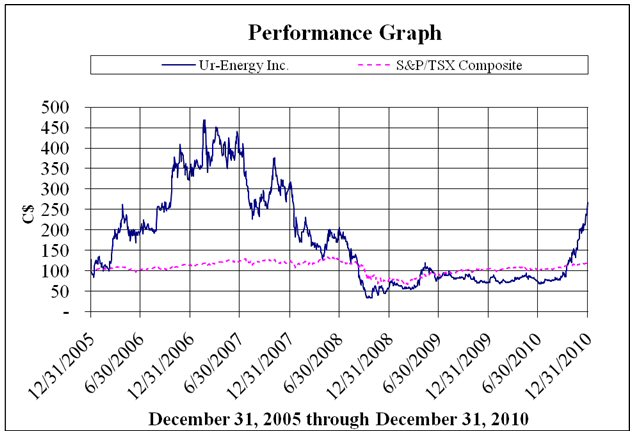
|
December 31, 2005
|
December 31, 2006
|
December 31, 2007
|
December 31, 2008
|
December 31, 2009
|
December 31, 2010
|
|
|
Ur-Energy Inc.
|
$ 100
|
$ 342
|
$ 313
|
$ 61
|
$ 72
|
$ 264
|
|
S&P/TSX Composite
|
$ 100
|
$ 115
|
$ 123
|
$ 80
|
$ 104
|
$ 119
|
Indebtedness of Directors, Executive Officers and Others
At no time since the beginning of the Corporation’s last financial year was any director, executive officer, proposed nominee for election as a director, or any of their respective associates, indebted to the Corporation or any of its subsidiaries, nor was the indebtedness of any such person to another entity the subject of any guarantee, support agreement, letter of credit or similar arrangement provided by the Corporation or any of its subsidiaries.
- 21 -
Compensation of Directors
In December 2008, the Compensation Committee reviewed the director compensation and recommended changes to the director compensation scheme which thereafter was adopted by the Compensation Committee and the Board of Directors in January 2009. Commencing in 2009, each non-management director receives a base cash retainer of $18,000. In addition to the base retainer, each non-management director receives compensation for each meeting attended ($1,000 attendance in person; $500 attendance by telephone). The non-management directors are also eligible to receive grants of options and RSUs at the discretion of the Board of Directors.
In addition, the Compensation Committee recommended, and Board of Directors adopted, a resolution requiring mandatory minimum share ownership by the non-management directors to encourage the alignment of interests between the Corporation and its shareholders. Non-management directors are required to invest an amount equal to the non-management director’s annual retainer in shares or securities exercisable into shares on or before the later of (i) December 31, 2013, or (ii) the fifth anniversary of the non-management director’s election or appointment. The retainer amount will be calculated using the amount of the annual retainer at the later of (i) January 1, 2009, or (ii) the date of the non-management director’s election or appointment.
In addition to other compensation received by directors of the Corporation, a 2008 resolution provides that non-management directors participating on ad hoc or special committees of the Board of Directors, which may be constituted from time to time, are entitled to additional director fees, to be determined in accordance with additional duties and requirements requested of those individuals from time to time.
|
Non-Management Director Compensation For the Financial Year Ended December 31, 2010
|
||||||||||||||||||
|
Name
|
Fees
earned
($)
|
Share-
based
awards
($)
|
Option-
based
awards
($)
|
Non-equity
incentive
plan
compensation
($)
|
Pension
value
($)
|
All other
compensation
($)
|
Total
($)
|
|||||||||||
|
Robert Boaz (1)
|
8,742 |
Nil
|
3,932 |
Nil
|
Nil
|
Nil
|
12,674 | |||||||||||
|
James M. Franklin (2)
|
23,000 |
Nil
|
3,894 |
Nil
|
Nil
|
7,500 | 34,394 | |||||||||||
|
Paul Macdonell
|
23,000 |
Nil
|
3,894 |
Nil
|
Nil
|
Nil
|
26,894 | |||||||||||
|
Thomas Parker
|
23,000 |
Nil
|
3,894 |
Nil
|
Nil
|
Nil
|
25,674 | |||||||||||
|
|
(1)
|
Mr. Boaz resigned as a director of the Corporation in May 2010.
|
|
|
(2)
|
Dr. Franklin performed consulting services under a consulting agreement with the Corporation.
|
- 22 -
EQUITY COMPENSATION PLAN INFORMATION
The following table sets forth certain summary information concerning the Corporation’s equity compensation plans as at December 31, 2010. Directors, officers, employees and consultants are eligible to participate in the Option Plan and RSU Plan.
|
Equity compensation plans approved by securityholders
|
Number of Common Shares to be Issued Upon Exercise of Outstanding Options, Warrants and Rights
|
Weighted Average Exercise Price of Outstanding Options, Warrants and Rights (C$)
|
Number of Common Shares Remaining for Future Issuance (Excluding Common Shares to be Issued Upon Exercise of Outstanding Options, Warrants and Rights)
|
|
Ur-Energy Inc. Amended and Restated Stock Option Plan 2005 (1)
|
5,665,568
|
$1.79
|
4,484,432
|
|
Ur-Energy Restricted Share Unit Plan(2)
|
-
|
-
|
|
|
(1)
|
The Corporation made a grant of 1,487,874 options for Common Shares on January 28, 2011.
|
|
|
(2)
|
The shareholders of the Corporation approved the RSU Plan in June 2010. No grants of RSUs were made in 2010. A grant of 355,662 RSUs was made on January 28, 2011.
|
INTERESTS OF INSIDERS IN MATERIAL TRANSACTIONS
Except as otherwise disclosed in this Circular, no insider of the Corporation or proposed nominee for election as a director of the Corporation, nor any of their respective associates or affiliates, has had any material interest, direct or indirect, in any transaction since the commencement of the Corporation’s last financial year or in any proposed transaction which has materially affected or will materially affect the Corporation or any of its subsidiaries.
Certain of the Corporation’s directors and officers also serve as directors and officers of one or more mining and exploration companies. Such directors and officers are also in many cases shareholders of one or more of the foregoing companies. While there is a potential for conflicts of interest to arise in such situations, that potential is minimized because of the nature of these other companies in other areas of mineral resources and precious metals. Except as otherwise disclosed in this Circular, no person who has been a director or officer of the Corporation since the commencement of the Corporation’s last financial year, nor any proposed nominee for election as a director of the Corporation, nor any of their respective associates or affiliates, has any material interest, direct or indirect, in any matter to be acted upon at the Meeting.
STATEMENT OF CORPORATE GOVERNANCE PRACTICES
Introduction
The Board of Directors believes that effective corporate governance contributes to improved corporate performance and enhanced shareholder value. The Board of Directors has reviewed the corporate governance best practices identified in National Policy 58-201 Corporate Governance Guidelines and National Instrument 58-101 Disclosure of Corporate Governance Practices (collectively, the “CSA Guidelines”). The Board of Directors is committed to ensuring that the Corporation follows best practices and is continuing to develop such practices.
- 23 -
Board Mandate
The responsibility of the Board of Directors is to supervise the management of the business and affairs of the Corporation in accordance with the best interests of the Corporation and all of its shareholders. The Board of Directors does not currently have a written mandate or a written description for the Chair of the Board of Directors or the Chief Executive Officer. In discharging its responsibility, the Board of Directors reviews the performance and responsibilities of the President and Chief Executive Officer and oversees and reviews the development and implementation of the following significant corporate plans and initiatives:
|
|
·
|
the Corporation’s strategic planning and budgeting process;
|
|
|
·
|
the identification of the principal risks to the Corporation’s business and the implementation of systems to manage these risks;
|
|
|
·
|
succession planning, including appointing, training and monitoring senior management;
|
|
|
·
|
the Corporation’s public communications policies and continuous disclosure record; and
|
|
|
·
|
the Corporation’s internal controls and management information systems.
|
The Board of Directors meets at least four times a year and more frequently if required. In 2010, the Board of Directors met six times. In addition, the Board of Directors took 11 actions by written resolution. The Board of Directors from time to time holds a portion of its meetings when management departs and the independent directors meet in camera. Management may be asked to depart a meeting for in camera sessions at such other meetings as the independent directors deem appropriate from time to time.
The Board of Directors recruits possible directors from contacts within the mining industry or other strategic areas that will complement the knowledge and depth of the Board of Directors. Currently, the Board of Directors has determined that five directors is an appropriate number of directors to oversee and provide guidance to management on the business and affairs of the Corporation. However, the Board of Directors continues to evaluate the size of the Board of Directors in conjunction with the continuing growth and development of the Corporation.
New directors who join the Board of Directors are provided with a basic orientation of the Corporation, the Board of Directors, the committees of the Board of Directors and meet with the other directors prior to joining the Board of Directors. In addition, new directors have the opportunity to meet with management of the Corporation to have an understanding of the business of the Corporation and its operations. Directors are encouraged to participate in corporate governance and education courses that will assist them in their role as directors of the Corporation or on various committees.
Board Composition
As of the time of the Meeting, the Board of Directors is composed of five directors. All directors are elected annually.
The current slate of five directors includes Mr. W. William Boberg, the President and Chief Executive Officer of the Corporation; Dr. James Franklin; Mr. Jeffrey Klenda, Chair of the Board of Directors of the Corporation; Mr. Paul Macdonell; and Mr. Thomas Parker. Messrs. Macdonell, Franklin and Parker are independent directors as determined by the CSA Guidelines (i.e., each is independent of management and free from any interest in and any business or other relationship with the Corporation which could reasonably be expected to interfere with the exercise of the director’s judgment). Dr. Franklin is a consultant to several companies. Based upon the nature of consulting for the Corporation and the level of
- 24 -
attendant consulting fees, Dr. Franklin previously was determined by the Board of Directors to be independent. In determining whether a director is independent, the Board of Directors considers the specific circumstances of a director and the nature, as well as materiality, of any relationship between the director and the Corporation.
From time to time, the Corporate Governance and Nominating Committee considers the functions customarily assigned to a director serving in the role of lead director and has determined that the establishment of the role of Lead Director at the Corporation, with the current makeup of the Board of Directors, would not enhance the communications within the Board, among its committees, and with management.
Several of the directors are directors for other reporting issuers, as disclosed in the biographies of the directors provided above.
Board Committees
There are five permanent Board of Directors committees: the Audit Committee, the Compensation Committee, the Corporate Governance and Nominating Committee, the Treasury & Investment Committee and the Technical Committee. The Board of Directors may also appoint other temporary or permanent committees from time to time for particular purposes.
The following sets out the Report of the Audit Committee as well as a summary of the responsibilities and activities of the other Board of Directors committees.
Audit Committee
The Audit Committee assists the Board of Directors in carrying out its responsibilities relating to corporate accounting and financial reporting practices, as well as oversight of internal controls, and the Whistleblower program. The duties and responsibilities of the Audit Committee include the following:
|
|
·
|
reviewing for recommendation to the Board of Directors for its approval the principal documents comprising the Corporation’s continuous disclosure record, including interim and annual financial statements and management’s discussion and analysis;
|
|
|
·
|
recommending to the Board of Directors a firm of independent auditors for appointment by the shareholders and reporting to the Board of Directors on the fees and expenses of such auditors. The Audit Committee has the authority and responsibility to select, evaluate and if necessary replace the independent auditor. The Audit Committee has the authority to approve all audit engagement fees and terms and the Audit Committee, or a member of the Audit Committee, must review and pre-approve any non-audit services provided to the Corporation by the Corporation’s independent auditor and consider the impact on the independence of the auditor;
|
|
|
·
|
reviewing periodic reports from the Chief Financial Officer;
|
|
|
·
|
discussing with management and the independent auditor, as appropriate, any audit problems or difficulties and management’s response; and
|
|
|
·
|
establishing procedures for the receipt, retention and treatment of complaints regarding accounting, internal accounting controls or auditing matters.
|
The Audit Committee maintains direct communication during the year with the Corporation’s independent auditor and the Corporation’s officers responsible for accounting and financial matters.
- 25 -
During 2010, the members of the Audit Committee were Thomas Parker (Chair), Paul Macdonell and Robert Boaz, and James Franklin following the resignation of Mr. Boaz in May 2010. Following the resignation of Mr. Boaz, Dr. Franklin was appointed to the Audit Committee as a temporary member, in reliance upon the exemption set out in Section 3.5 of National Instrument 52-110 Audit Committees (“NI 52-110”) and the Board of Directors determined that Dr. Franklin’s participation on the Audit Committee would not materially adversely affect the ability of the Audit Committee to act independently and satisfy the other requirements of NI 52-110. The Corporation’s consulting agreement with Dr. Franklin was concluded thereafter. In October 2010, Dr. Franklin was appointed a member of the Audit Committee after further consideration of his independence, pursuant to NI 52-110.
Currently, all the members of the Audit Committee are independent directors pursuant to NI 52-110 and the listing standards of the NYSE Amex. Each of the members is financially literate as defined in NI 52-110. The Audit Committee designated Robert Boaz as an “audit committee financial expert” as that term is currently defined by the rules of the U.S. Securities and Exchange Commission regulating these disclosures. Following the resignation of Mr. Boaz, the Audit Committee and the Board of Directors designated Mr. Parker as an “audit committee financial expert” as that term is currently defined by the rules of the U.S. Securities and Exchange Commission regulating these disclosures.
Report of the Audit Committee
During 2010, the Audit Committee met five times. In addition, the Audit Committee took one action by resolution. The activities of the Audit Committee over the past year included the following:
|
|
·
|
reviewing annual financial statements of the Corporation and management’s discussion and analysis prior to filing with the regulatory authorities;
|
|
|
·
|
reviewing the quarterly interim financial statements of the Corporation and management’s discussion and analysis prior to filing with regulatory authorities;
|
|
|
·
|
reviewing periodic reports from the Chief Financial Officer including communications from the Canadian regulatory authorities and the U.S. Securities and Exchange Commission;
|
|
|
·
|
reviewing applicable Canadian corporate disclosure reporting and control processes, including Chief Executive Officer and Chief Financial Officer certifications;
|
|
|
·
|
reviewing and approval of International Financial Reporting Standards changeover and project management plan, and subsequently recommending cessation of the changeover in favor of reporting in US GAAP commencing January 1, 2011;
|
|
|
·
|
reviewing Audit Committee governance practices to ensure its terms of reference incorporate all regulatory requirements; and
|
|
|
·
|
reviewing the engagement letter with the independent auditors and annual audit fees prior to approval by the Board of Directors, as well as pre-approving non-audit services and their cost prior to commencement.
|
The Audit Committee has reviewed and discussed with management and the independent auditors the Audited Consolidated Financial Statements of the Corporation as at December 31, 2010 and Management’s Discussion and Analysis. Based on that review and on the report of the independent auditor of the Corporation, the Audit Committee recommended to the Board of Directors that such Financial Statements and Management’s Discussion and Analysis be approved and filed with Canadian regulatory authorities and the U.S. Securities and Exchange Commission.
The Audit Committee has recommended to the Board of Directors that the shareholders of the Corporation be requested to re-appoint PricewaterhouseCoopers LLP, Chartered Accountants, as the independent auditor for 2011
- 26 -
The Audit Committee reviews its charter on a yearly basis, and did so most recently on March 4, 2011. A copy of the Amended and Restated Audit Committee Charter adopted on August 7, 2008, and which remains unchanged, is attached as an exhibit to the Annual Information Form of the Corporation (and the Annual Report on Form 40-F) for the year ended December 31, 2010, which is available electronically at www.sedar.com, having been filed on March 18, 2011. The Annual Information Form and the Annual Report on Form 40-F for the year ended December 31, 2010 (filed on www.sedar.com on March 18, 2011) contains disclosure relating to the composition of the Audit Committee and the qualifications of each of its members.
Compensation Committee
The Compensation Committee assists the Board of Directors in carrying out its responsibilities relating to personnel matters, including performance, compensation and succession. The Compensation Committee has prepared terms of reference which include annual objectives against which to assess members of management including the President and Chief Executive Officer, reviewing and making recommendations to the Board of Directors with respect to employee and consultant compensation arrangements including stock options and management succession planning. The Compensation Committee reviews its charter on a yearly basis, and did so most recently on March 4, 2011.
The Compensation Committee met three times in 2010. In addition, the Compensation Committee took five actions by written resolution. Portions of meetings are conducted without management present, including for the purpose of specifically discussing the compensation of the President and Chief Executive Officer. During 2010, the members of the Committee were Paul Macdonell (Chair) and Thomas Parker. Robert Boaz served as a member of the Compensation Committee until his resignation in May 2010. James Franklin was appointed as a member of the Compensation Committee in March 2011. Messrs. Macdonell and Parker and Dr. Franklin continue to serve as the Compensation Committee; Mr. Macdonell remains the Chair of the Committee. The members of the Compensation Committee were in 2010, and are currently, independent pursuant to NI 52-110 and the listing standards of the NYSE Amex.
Corporate Governance and Nominating Committee
The Board of Directors constituted a Corporate Governance and Nominating Committee on December 17, 2007. The Corporate Governance and Nominating Committee assists the Board of Directors with determining the slate of director nominees for election to the Board of Directors, recommending candidates to fill vacancies, the composition of the Committees of the Board of Directors and monitoring compliance with corporate governance regulatory requirements. The Corporate Governance and Nominating Committee Charter was adopted by the Board of Directors on December 17, 2007. The Corporate Governance and Nominating Committee reviews its charter on a yearly basis, most recently on March 4, 2011.
During 2010, the members of the Committee were Paul Macdonell (Chair) and Thomas Parker. Robert Boaz served as Chair of the Corporate Governance and Nominating Committee until his resignation in May 2010. James Franklin was appointed as a member of the Compensation Committee in March 2011. The Corporate Governance and Nominating Committee met once in 2010. Messrs. Macdonell and Parker and Dr. Franklin continue to serve as the Corporate Governance and Nominating Committee; Mr. Macdonell remains the Chair of the Committee. The members of the Corporate Governance and Nominating Committee were in 2010, and are currently, independent pursuant to NI 52-110 and the listing standards of the NYSE Amex.
- 27 -
Treasury & Investment Committee
In August 2007 the Board of Directors constituted a Treasury & Investment Committee. The Treasury & Investment Committee assists the Board of Directors by centralizing for oversight all treasury activities of the Corporation insofar as practical, and coordinating the banking, cash management, investment and funding arrangements of the Corporation. The Committee also formulates and implements the Treasury and Investment Policy of the Corporation, reviewing it from time to time. The Committee’s Charter provides that the Committee consist of the CFO and at least two independent members of the Board of Directors. The Treasury & Investment Committee reviews its charter on an annual basis, most recently on March 4, 2011.
During 2010, the members of the Treasury & Investment Committee were Thomas Parker (Chair), Paul Macdonell, along with the Corporation’s CFO. Robert Boaz was a member of the Treasury & Investment Committee until his resignation in May 2010. The Treasury & Investment Committee met once during 2010. Messrs. Macdonell and Parker continue as members of the Treasury & Investment Committee, along with the Corporation’s CFO.
Technical Committee
The Board of Directors constituted a Technical Committee on January 29, 2008. The Technical Committee assists the Board of Directors in reviewing and evaluating the quality, effectiveness and progress of exploration and development projects. The Technical Committee also advises on matters related to new and updated technologies which may be employed by the Corporation and to review environmental matters and protocols with respect to the Corporation’s projects. The Technical Committee “Mandate and Guidelines” document was adopted by the Board of Directors on January 29, 2008.
The members of the Technical Committee are James Franklin (Chair), Thomas Parker and W. William Boberg. There are several members of management who participate in the Technical Committee. The Technical Committee conducts many of its reviews by means of informal meetings, including as a part of the Corporation’s annual in-house technical review symposiums. The Technical Committee did not hold formal meetings during 2010. The members of the Technical Committee are not required to be independent pursuant to NI 52-110.
Ad Hoc Committee related to Screech Lake
As of December 2007, an Ad Hoc Committee on matters related to Screech Lake was constituted by the Board of Directors. The Ad Hoc Committee was discontinued in March 2010, based upon management’s decision that the continuing work on the Screech Lake project, including necessary consultations with the Lutsel K’e community and governmental officials, now will be facilitated by in-house personnel.
- 28 -
Summary of Memberships on Permanent Committees and Record of Attendance for 2010
During the year ended December 31, 2010, the Board of Directors and its permanent committees held the following numbers of meetings:
|
Board of Directors
|
6 (1)
|
|
|
Audit Committee (“AC”)
|
5
|
|
|
Compensation Committee (“CC”)
|
3
|
|
|
Corporate Governance and Nominating Committee (“CGN”)
|
1
|
|
| Treasury & Investment Committee (“TIC”) |
1
|
|
|
Total number of meetings held
|
16
|
(1) In addition to the nine meetings held by the Board of Directors, 11 actions were taken by resolution in writing.
|
Director
|
Committee
Memberships
|
Board Meetings Attended
|
Committee Meetings Attended
|
|
Jeffrey T. Klenda
|
6
|
||
|
James M. Franklin
|
AC, TC
|
6
|
AC – 2(1), TC - N/A (2);
|
|
Paul Macdonell
|
AC, CC, CGN, TIC
|
6
|
AC – 4, CC –3, CGN – 1,
TIC – 1
|
|
Robert Boaz
|
AC, CC, CGN, TIC
|
3(3)
|
AC – 3, CC –3, CGN –1,
TIC – 1
|
|
W. William Boberg
|
TC
|
6
|
TC - N/A(2)
|
|
Thomas Parker
|
AC, CC, CGN, TIC, TC
|
6
|
AC –5, CC – 3, CGN-1,
TIC –1 , TC-N/A(2)
|
|
|
(1)
|
Dr. Franklin attended the two Audit Committee meetings held after his appointment as a member of the Committee.
|
|
|
(2)
|
As noted above, the Technical Committee did not hold formal meetings during 2010.
|
|
|
(3)
|
Mr. Boaz attended the three Board of Directors’ meetings held prior to his resignation. He was also in attendance at all committee meetings held prior to his resignation.
|
Other Policies
The Corporation adopted a written Code of Business Conduct and Ethics (the “Code”) on August 9, 2007 which has been amended and restated from time to time, most recently effective February 1, 2010. All directors, officers and employees of the Corporation are expected to be familiar with the Code and to adhere to those principles and procedures set forth in the Code that apply to them. Directors, officers and appropriate personnel reaffirm their familiarity and adherence to the Code on an annual basis. The Corporate Governance and Nominating Committee oversees the implementation of the Code and compliance with various regulatory requirements. The Code is available at the Corporation’s website at www.ur-energy.com.
The Corporation also adopted various policies related to trading restrictions, disclosure requirements and confidentiality obligations on January 29, 2008 which have been amended and restated from time to time, most recently effective February 4, 2010. The Corporate Governance and Nominating Committee oversees the implementation and compliance of these policies. These policies, the “Ur-Energy Inc. Policies Concerning Confidentiality, Public Disclosure and Restrictions on Trading Securities,” also are available at the Corporation’s website. All directors, officers and employees of the Corporation are expected to be familiar with and adhere to the policies.
- 29 -
Shareholder Feedback
The Board of Directors believes that management should speak for the Corporation in its communications with shareholders and others in the investment community and that the Board of Directors should be satisfied that appropriate investor relations programs and procedures are in place. The Board of Directors has approved these policies including the designation of spokespersons of behalf of the Corporation from time to time. Management meets regularly with shareholders and others in the investment community to receive and respond to shareholder feedback.
The Board of Directors regularly reviews the Corporation’s major communications with shareholders and the public, including continuous disclosure documents and periodic press releases in accordance with the Corporation’s policies.
Expectations of Management
The Board of Directors believes that it is appropriate for management to be responsible for the development of long-term strategies for the Corporation. Meetings of the Board of Directors are held, as required, to specifically review and deal with long-term strategies of the Corporation as presented by senior members of management.
The Board of Directors appreciates the value of having selected executive officers attend board meetings to provide information and opinions to assist the directors in their deliberations. The Chair, in consultation with the President and Chief Executive Officer, arranges for the attendance of executive officers as well as managers for consultation including technical presentations at board meetings.
SHAREHOLDER PROPOSALS
All proposals of the Corporation’s shareholders intended to be presented at the Corporation’s annual meeting of shareholders in 2012, must be received by the Corporation’s Corporate Secretary no later than January 15, 2012 for inclusion in the proxy circular related to that meeting. The Corporation’s next annual meeting of shareholders is planned for April 2012.
ADDITIONAL INFORMATION
Additional financial information for the Corporation is available in the Corporation’s audited consolidated financial statements for the year ended December 31, 2010 and related management’s discussion and analysis of financial condition and results of operations for the year ended December 31, 2010, which have been filed with Canadian securities regulators and are available under the Corporation’s profile at www.sedar.com, and are filed with the U.S. Securities and Exchange Commission at www.sec.gov.
Upon request made to the Secretary of the Corporation at 10758 West Centennial Road, Suite 200, Littleton, Colorado 80127 USA (Telephone: 720-981-4588 ext. 225), the Secretary will provide to any shareholder of the Corporation, free of charge, a copy of its audited consolidated financial statements for the year ended December 31, 2010 and related management’s discussion and analysis of financial condition and results of operations for the year ended December 31, 2010.
- 30 -
APPROVAL BY BOARD OF DIRECTORS
The contents and the sending of this Circular have been approved by the Board of Directors of the Corporation.
DATED at Denver, Colorado, this 23rd day of March 2011.
By Order of the Board of Directors
/s/ W. William Boberg
President and Chief Executive Officer
- 31 -
SCHEDULE A
Ur-Energy Inc. Amended and Restated Stock Option Plan 2005
Resolution
RESOLVED THAT:
|
1.
|
The renewal of Ur-Energy Inc. Amended and Restated Stock Option Plan 2005 (the “Option Plan”), which was adopted in connection with the initial public offering of the Corporation in November 2005, ratified, confirmed and approved by the shareholders on May 8, 2008, and was last modified by resolution of the Board of Directors on July 28, 2010, be and is hereby ratified, confirmed and approved;
|
|
2.
|
All unallocated options issuable pursuant to the Option Plan be and are hereby approved and authorized until the third anniversary date of the adoption of the present resolution by the shareholders of the Corporation; and
|
|
3.
|
Any director or officer of the Corporation be and each of them is hereby authorized, for and on behalf of the Corporation, to do such things and to sign, execute and deliver all such documents that such director or officer may, in their discretion, determine to be necessary or useful in order to give full effect to the intent and purpose of this resolution.
|
A -1
SCHEDULE B
UR-ENERGY INC.
AMENDED AND RESTATED STOCK OPTION PLAN
2005
|
1.
|
PURPOSE OF THE PLAN
|
|
1.1
|
The purpose of the Plan is to attract, retain and motivate persons of training, experience and leadership to the Corporation and its Subsidiaries, including their directors, officers, employees and service providers, and to advance the interests of the Corporation by providing such persons with the opportunity, through share options, to acquire an increased proprietary interest in the Corporation.
|
|
2.
|
DEFINED TERMS
|
Where used herein, the following terms shall have the following meanings, respectively:
|
2.1
|
“Board” means the Board of Directors of the Corporation or, if established and duly authorized to act, the Executive Committee of the Board of Directors of the Corporation;
|
|
2.2
|
“Change of Control” includes:
|
|
|
(i)
|
the acquisition by any persons acting jointly or in concert (as determined by the Securities Act), whether directly or indirectly, of voting securities of the Corporation that, together with all other voting securities of the Corporation held by such persons, constitute in the aggregate more than 50% of all outstanding voting securities of the Corporation;
|
|
|
(ii)
|
an amalgamation, arrangement or other form of business combination of the Corporation with another corporation that results in the holders of voting securities of that other corporation holding, in the aggregate, more than 50% of all outstanding voting securities of the corporation resulting from the business combination;
|
|
|
(iii)
|
the sale, lease or exchange of all or substantially all of the property of the Corporation to another person, other than in the ordinary course of business of the Corporation or to a Related Entity; or
|
|
|
(iv)
|
any other transaction that is deemed to be a “Change of Control” for the purposes of this Plan by the Board in its sole discretion;
|
|
2.3
|
“Committee” shall have the meaning attributed thereto in Section 3.1 hereof;
|
|
2.4
|
“Control” by a person over a second person means the power to direct, directly or indirectly, the management and policies of the second person by virtue of:
|
|
|
(i)
|
ownership of or direction over voting securities in the second person;
|
B - 1
|
|
(ii)
|
a written agreement or indenture
|
|
|
(iii)
|
being or Controlling the general partner of the second person; or
|
|
|
(iv)
|
being a trustee of the second person;
|
|
2.5
|
“Corporation” means Ur-Energy Inc. and includes any successor corporation thereof;
|
|
2.6
|
“Eligible Person” means:
|
|
|
(i)
|
any Insider, director, officer or employee of the Corporation or any Subsidiary, or any other Service Provider (an “Eligible Individual”); or
|
|
|
(ii)
|
a corporation controlled by an Eligible Individual, the issued and outstanding voting shares of which are, and will continue to be, beneficially owned, directly or indirectly, by such Eligible Individual and/or the spouse, children and/or grandchildren of such Eligible Individual (an “Employee Corporation”);
|
|
2.7
|
“Insider” means any insider, as such term is defined in Subsection 1(1) of the Securities Act (Ontario), of the Corporation, other than a person who falls within that definition solely by virtue of being a director or senior officer of a Subsidiary, and includes any associate, as such term is defined in Subsection 1(1) of the Securities Act (Ontario), of any such insider;
|
|
2.8
|
“Market Price” at any date in respect of the Shares means the closing sale price of such Shares on the TSX (or, if such Shares are not then listed and posted for trading on the TSX, then on the recognized stock exchange on which such Shares are listed on which the greatest volume of them were traded during the period referenced below or, if such Shares are not so listed on any recognized stock exchange, then on the over-the-counter market on which they are traded as selected for such purpose by the Committee) on the trading day immediately preceding such date. In the event that such Shares did not trade on such trading day, the Market Price shall be the average of the bid and ask prices in respect of such Shares at the close of trading on such trading day;
|
|
2.9
|
“Option” means an option to purchase Shares granted to an Eligible Person under the Plan;
|
|
2.10
|
“Option Price” means the price per Share at which Shares may be purchased under an Option, as the same may be adjusted from time to time in accordance with Article 8 hereof;
|
|
2.11
|
“Optioned Shares” means the Shares issuable pursuant to an exercise of Options;
|
|
2.12
|
“Optionee” means an Eligible Person to whom an Option has been granted and who continues to hold such Option;
|
|
2.13
|
“Plan” means this Amended and Restated Stock Option Plan, as the same may be further amended or varied from time to time;
|
|
2.14
|
“Related Entity” means, for the Corporation, a person that Controls or is Controlled by the Corporation or that is Controlled by the same person that controls the Corporation;
|
B - 2
|
2.15
|
“Service Provider” means any person or company engaged as an independent contractor or otherwise to provide ongoing management or consulting services for the Corporation or for any entity controlled by the Corporation; |
|
2.16
|
“Shares” means the Common Shares of the Corporation or, in the event of an adjustment contemplated by Article 8 hereof, such other shares or securities to which an Optionee may be entitled upon the exercise of an Option as a result of such adjustment;
|
|
2.17
|
“Subsidiary” means any corporation which is a subsidiary, as such term is defined in Subsection 1(2) of the Canada Business Corporations Act, of the Corporation; and
|
|
2.18
|
“TSX” means the Toronto Stock Exchange.
|
|
3.
|
ADMINISTRATION OF THE PLAN
|
|
3.1
|
The Plan shall be administered by the Board or, if determined by the Board, by the Board with the assistance of the compensation committee (the “Committee”) of the Board.
|
|
3.2
|
The Committee shall have the power, where consistent with the general purpose and intent of the Plan and subject to the specific provisions of the Plan:
|
|
|
(a)
|
to establish policies and to adopt rules and regulations for carrying out the purposes, provisions and administration of the Plan;
|
|
|
(b)
|
to interpret and construe the Plan and to determine all questions arising out of the Plan or any Option, and any such interpretation, construction or determination made by the Committee shall be final, binding and conclusive for all purposes;
|
|
|
(c)
|
to determine the number of Shares covered by each Option;
|
|
|
(d)
|
to determine the Option Price of each Option;
|
|
|
(e)
|
to determine the time or times when Options will be granted and exercisable;
|
|
|
(f)
|
to determine if the Shares which are issuable on the exercise of an Option will be subject to any restrictions upon the exercise of such Option; and
|
|
|
(g)
|
to prescribe the form of the instruments relating to the grant, exercise and other terms of Options.
|
|
3.3
|
The Committee may, in its discretion, require as conditions to the grant or exercise of any Option that the Optionee shall have:
|
|
|
(a)
|
represented, warranted and agreed in form and substance satisfactory to the Corporation that he or she is acquiring and will acquire such Option and the Shares to be issued upon the exercise thereof or, as the case may be, is acquiring such Shares, for his or her own account, for investment and not with a view to or in connection with any distribution, that he or she has had access to such information as is necessary to enable him or her to evaluate the merits and risks of such investment and that he or she is able to bear the economic risk of holding such Shares for an indefinite period;
|
B - 3
|
|
(b)
|
agreed to restrictions on transfer in form and substance satisfactory to the Corporation and to an endorsement on any option agreement on certificate representing the Shares making appropriate reference to such restrictions; and |
|
|
(c)
|
agreed to indemnify the Corporation in connection with the foregoing.
|
|
3.4
|
Any Option granted under the Plan shall be subject to the requirement that, if at any time counsel to the Corporation shall determine that the listing, registration or qualification of the Shares subject to such Option upon any securities exchange or under any law or regulation of any jurisdiction, or the consent or approval of any securities exchange or any governmental or regulatory body, is necessary as a condition of, or in connection with, the grant or exercise of such Option or the issuance or purchase of Shares thereunder, such Option may not be accepted or exercised in whole or in part unless such listing, registration, qualification, consent or approval shall have been effected or obtained on conditions acceptable to the Committee. Nothing herein shall be deemed to require the Corporation to apply for or to obtain such listing, registration, qualification, consent or approval.
|
|
3.5
|
The Chief Executive Officer of the Corporation may grant Options, in the context of non-executive employment or consulting arrangements, from time to time between the dates of meetings of the Board in the amount of up to 100,000 Shares in aggregate and upon the reporting from time to time of the grant of such Options to the Board, the amount available for such grants by the Chief Executive Officer shall be restored to the full amount of 100,000 Shares.
|
|
4.
|
SHARES SUBJECT TO THE PLAN
|
|
4.1
|
Subject to adjustment as provided in Article 8 hereof, the Shares to be offered under the Plan shall consist of the Corporation’s authorized but unissued common shares. The aggregate number of Shares issuable upon the exercise of all options granted under the Plan shall not exceed 10% of the issued and outstanding shares of the Corporation as at the date of grant of each Option under the Plan. If any Option granted hereunder shall expire or terminate for any reason in accordance with the terms of the Plan without being exercised, the un-purchased shares subject thereto shall again be available for the purpose of this Plan.
|
|
5.
|
ELIGIBILITY; GRANT; TERMS OF OPTIONS
|
|
5.1
|
Options may be granted to any Eligible Person in accordance with Section 5.2 hereof.
|
|
5.2
|
Options may be granted by the Corporation pursuant to the recommendations of the Committee from time to time provided and to the extent that such decisions are approved by the Board.
|
|
5.3
|
Subject as herein and otherwise specifically provided in this Article 5, the number of Shares subject to each Option, the Option Price of each Option, the expiration date of each Option, the extent to which each Option is exercisable from time to time during the term of the Option and other terms and conditions relating to each such Option shall be determined by the Committee.
|
|
5.4
|
In the event that no specific determination is made by the Committee with respect to any of the following matters, each Option shall, subject to any other specific provisions of the Plan, contain the following terms and conditions:
|
B - 4
|
|
(a)
|
the period during which an Option shall be exercisable shall be 5 years from the date the Option is granted to the Optionee; and |
|
|
(b)
|
the Optionee may exercise the Option for not more than 10% of the Shares covered by the Option on the date of the grant of the Option, as to not more than an additional 22%, four and one half months after the date of grant, as to not more than an additional 22%, nine months after the date of grant, as to an additional 22%, thirteen and one half months after the date of grant and as to the final 24%, eighteen months after the date of grant,
|
subject to the right of the Board to determine at the time of grant that a particular Option will be exercisable in whole or in part on different dates and to determine at any time after the date of grant that a particular Option will be exercisable in whole or in part on earlier dates for any reason, including the occurrence of a proposal by the Corporation or any other person to implement a transaction that would, if implemented, result in a Change of Control.
|
5.5
|
Subject to any adjustments pursuant to the provisions of Article 8 hereof, the Option Price of any Option shall be in no circumstances be lower than the Market Price on the trading day immediately preceding the date of which the grant of the Option is approved by the Committee. Notwithstanding the foregoing, in the event that the Shares are not listed on any stock exchange on the date on which the grant of an Option is approved by the Committee, the Option Price for such Option shall be determined by the Committee. If, as and when any Shares have been duly purchased and paid for under the terms of an Option, such Shares shall be conclusively deemed allotted and issued as fully paid non-assessable Shares at the price paid therefor.
|
|
5.6
|
No Options shall be granted to any Optionee if the total number of Shares issuable to such Optionee under this Plan, together with any Shares reserved for issuance to such Optionee under options for services or any other stock option plans, would exceed 5% of the issued and outstanding Shares.
|
|
5.7
|
An Option is personal to the Optionee and non-assignable (whether by operation of law or otherwise), except as provided for herein. Upon any attempt to transfer, assign, pledge, hypothecate or otherwise dispose of an Option contrary to the provisions of the Plan, or upon the levy of any attachment or similar process upon an Option, the Option shall, at the election of the Corporation, cease and terminate and be of no further force or effect whatsoever.
|
|
5.8
|
No Options shall be granted to an Optionee if such grant could result, at any time, in:
|
|
|
(a)
|
the number of Shares reserved for issuance pursuant to Options or other stock options granted to Insiders exceeding 10% of the issued and outstanding Shares;
|
|
|
(b)
|
the issuance to Insiders, within a one-year period, of a number of Shares exceeding 10% of the issued and outstanding Shares; or
|
|
|
(c)
|
the issuance to any one Insider and such Insider’s associates, within a one-year period, of a number of Shares exceeding 5% of the issued and outstanding Shares.
|
For the purposes of this Section 5.8, the phrase “issued and outstanding Shares” excludes any Shares issued pursuant to the Plan or other stock options, stock option plans, employee stock purchase plans or other compensation or incentive mechanisms, over a preceding one-year period and “associate” means any person associated with such Insider.
B - 5
|
6.
|
TERMINATION OF EMPLOYMENT; DEATH
|
|
6.1
|
Subject to (i) the provisions of this Article 6, (ii) any express resolutions passed by the Committee or Board, or (iii) any provisions specifically included in employment agreements or other written arrangement with Eligible Persons, an Option and all rights to purchase Shares pursuant thereto shall expire and terminate immediately upon the Optionee who holds such Option ceasing to be an Eligible Person.
|
|
6.2
|
If, before the expiry of an Option in accordance with the terms thereof, an Optionee shall cease to be an Eligible Person (an “Event of Termination”) for any reason other than termination for “cause” of his or her employment with the Corporation or any Subsidiary, or except as set out in Section 6.7, then the Optionee may:
|
|
|
(a)
|
exercise the Option to the extent that he or she was entitled to do so at the time of such Event of Termination, at any time up to and including, but not after, a date three (3) months following the date of such Event of Termination, or prior to the close of business on the expiration date of the Option, whichever is earlier; and
|
|
|
(b)
|
with the prior written consent of the Board or the Committee, which consent may be withheld in the Corporation’s sole discretion, exercise a further Option at any time up to and including, but not after, a date three (3) months following the date of such Event of Termination, or prior to the close of business on the expiration date of the Option, whichever is earlier, to purchase all or any of the Optioned Shares as the Board or the Committee may designate but not exceeding the number of Optioned Shares the Optionee would have otherwise been entitled to purchase pursuant to the Option had the Optionee’s status as an Eligible Person been maintained for the term of the Option.
|
|
6.3
|
If an Optionee dies before the expiry of an Option in accordance with the terms thereof, the Optionee’s legal representative(s) may, subject to the terms of the Option and the Plan:
|
|
|
(a)
|
exercise the Option to the extent that the Optionee was entitled to do so at the date of his or her death at any time up to and including, but not after, a date one year following the date of death of the Optionee, or prior to the close of business on the expiration date of the Option, whichever is earlier; and
|
|
|
(b)
|
with the prior written consent of the Board or the Committee, exercise at any time up to and including, but not after, a date one year following the date of death of the Optionee, a further Option to purchase all or any of the Optioned Shares as the Board or the Committee may designate but not exceeding the number of Optioned Shares the Optionee would have otherwise been entitled to purchase had the Optionee survived.
|
|
6.4
|
For greater certainty, Options shall not be affected by any change of employment of the Optionee or by the Optionee ceasing to be a director of the Corporation provided that the Optionee continues to be an Eligible Person.
|
|
6.5
|
For the purposes of this Article 6, a determination by the Corporation that an Optionee was discharged for “cause” shall be binding on the Optionee; provided, however, that such determination shall not be conclusive of the Optionee’s potential entitlement to damages for the loss of the right to exercise an Option in the event that a court of competent jurisdiction ultimately determines that the discharge was without “cause”.
|
B - 6
|
6.6
|
If the Optionee is an Employee Corporation, the references to the Optionee in this Article 6 shall be deemed to refer to the Eligible Individual associated with the Employee Corporation. |
|
6.7
|
Notwithstanding the provisions of this Article 6:
|
|
|
(a)
|
all vested Options held by an officer of the Corporation, as designated by the Board of the Corporation (a “Designated Officer”), provided such person has been a Designated Officer for at least one year, will expire on the expiration date identified at the time of grant of the Option and all unvested Options will expire upon the date of termination whether as a result of resignation or termination by the Corporation without cause;
|
|
|
(b)
|
all vested Options held by a director on the Board of the Corporation, provided such person has been a director for at least one year, whether as a result of appointment or election to the Board, will expire on the expiration date identified at the time of grant of the Option and all unvested Options will expire on the date of termination whether as a result of resignation or failure to be re-elected to the Board; and
|
|
|
(c)
|
nothing in this Section 6.7 will be construed as extending an Option beyond the expiration date identified at the time of grant of the Option and in accordance with the Plan.
|
|
7.
|
EXERCISE OF OPTIONS
|
|
7.1
|
Subject to the provisions of the Plan, an Option may be exercised from time to time by delivery to the Corporation at its registered office of a written notice of exercise addressed to the Secretary of the Corporation specifying the number of Shares with respect to which the Option is being exercised and accompanied by payment in full, by cash or cheque, of the Option Price of the Shares then being purchased. Certificates for such Shares shall be issued and delivered to the Optionee within a reasonable time following the receipt of such notice and payment.
|
|
7.2
|
Notwithstanding any of the provisions contained in the Plan or in any Option, the Corporation’s obligation to issue Shares to an Optionee pursuant to the exercise of any Option shall be subject to:
|
|
|
(a)
|
completion of such registration or other qualification of such Shares or obtaining approval of such governmental or regulatory authority as the Corporation shall determine to be necessary or advisable in connection with the authorization, issuance or sale thereof;
|
|
|
(b)
|
the administration of such Shares to listing on any stock exchange on which the Shares may then be listed;
|
|
|
(c)
|
the receipt from the Optionee of such representations, warranties, agreements and undertakings, as the Corporation determines to be necessary or advisable in order to safeguard against the violation of the securities laws of any jurisdiction; and
|
|
|
(d)
|
the satisfaction of any conditions on exercise prescribed pursuant to Section 3.4 hereof,
|
in this connection the Corporation shall, to the extent necessary, take all commercially reasonable steps to obtain such approvals, registrations, and qualifications as may be necessary for the
B - 7
issuance of such Shares in compliance with applicable securities laws and for the listing of such Shares on any stock exchange on which the Share are then listed.
|
7.3
|
Options shall be evidenced by a share option agreement, instrument or certificate in such form not inconsistent with this Plan as the Committee may from time to time determine as provided for under Subsection 3.2(g), provided that the substance of Article 5 be included therein.
|
|
8.
|
CERTAIN ADJUSTMENTS
|
|
8.1
|
In the event of any subdivision or redivision of the Shares into a greater number of Shares at any time after the grant of an Option to any Optionee and prior to the expiration of the term of such Option, the Corporation shall deliver to such Optionee at the time of any subsequent exercise of his or her Option in accordance with the terms hereof, in lieu of the number of shares to which he or she was theretofore entitled upon such exercise, but for the same aggregate consideration payable therefor, such number of Shares as such Optionee would have held as a result of such subdivision or redivision if, on the record date thereof, the Optionee had been the registered holder of the number of Shares to which he or she was theretofore entitled upon such exercise.
|
|
8.2
|
In the event of any consolidation of the Shares into a lesser number of Shares at any time after the grant of an Option to any Optionee and prior to the expiration of the term of such Option, the Corporation shall deliver to such Optionee at the time of any subsequent exercise of his or her Option in accordance with the terms hereof, in lieu of the number of Shares to which he or she was theretofore entitled upon such exercise, but for the same aggregate consideration payable therefor, such number of Shares as such Optionee would have held as a result of such consolidation if, on the record date thereof, the Optionee had been the registered holder of the number of Shares to which he or she was theretofore entitled upon such exercise.
|
|
8.3
|
Subject to the provisions of Article 9, if at any time after the grant of any Option to an Optionee and prior to the expiration of the term of such Option, the Shares shall be reclassified, reorganized or otherwise changed, otherwise than as specified in Sections 8.1 and 8.2 or the Corporation shall consolidate, merge or amalgamate with or into another corporation (the corporation resulting or continuing from such consolidation, merger or amalgamation being herein called the “Successor Corporation”) or, the Corporation shall pay a stock dividend (other than any dividends in the ordinary course), the Optionee shall be entitled to receive upon the subsequent exercise of his or her Option in accordance with the terms hereof and shall accept in lieu of the number of Shares to which he or she was theretofore entitled upon such exercise but for the same aggregate consideration payable therefor, the aggregate the number of shares of the appropriate class and/or other securities of the Corporation or the Successor Corporation (as the case may be) that the Optionee would have been entitled to receive as a result of such reclassification, reorganization or other change or as a result of such consolidation, merger, amalgamation, or stock dividend, if on the record date of such reclassification, reorganization, other change or stock dividend, or the record date of such consolidation, merger or amalgamation or dividend payment, as the case may be, he or she had been the registered holder of the number of Shares to which he or she was theretofore entitled upon such exercise.
|
|
8.4
|
Notwithstanding any other provision herein, in the event of a Change of Control all Options, whether vested or unvested, will become fully vested and exercisable immediately prior to the date of a Change of Control without notice to Optionees.
|
B - 8
|
8.5
|
In the event the Corporation should declare and pay a special cash dividend or other distribution out of the ordinary course, a special dividend in specie on the Shares, or a stock dividend other than in the ordinary course, the Option Price of all Options outstanding on the record date of such dividend or other distribution shall be reduced by an amount equal to the cash payment or other distribution or the fair market value of the dividend in specie or stock dividend or other distribution, as determined by the Committee in its sole discretion.
|
|
9.
|
AMENDMENT OR DISCONTINUANCE OF THE PLAN
|
|
9.1
|
Subject to applicable regulatory requirements and except as provided herein, the Board may, in its sole and absolute discretion and without shareholder approval, amend, suspend, terminate or discontinue the Plan and may amend the terms and conditions of Options granted pursuant to the Plan. Provided, however, that if the Board wishes to increase the maximum percentage in Section 4.1 hereof or extend the Option period or reduce the Option Price of Options granted to Insiders of the Corporation pursuant to the Plan, shareholder approval will be required.
|
|
9.2
|
Without limiting the generality of the foregoing, the Board may make the following amendments to the Plan, without obtaining shareholder approval:
|
|
|
(a)
|
amendments to the terms and conditions of the Plan necessary to ensure that the Plan complies with the applicable regulatory requirements, including the rules of the TSX, in place from time to time;
|
|
|
(b)
|
amendments to the provisions of the Plan respecting administration of the Plan and eligibility for participation under the Plan;
|
|
|
(c)
|
amendments to the provisions of the Plan respecting the terms and conditions on which options may be granted pursuant to the Plan, including the provisions relating to the option price, the option period and the vesting schedule; and
|
|
|
(d)
|
amendments to the Plan that are of a “housekeeping” nature.
|
|
9.3
|
Without limiting the generality of the foregoing, the Board may amend the Option Price, the option period, the vesting schedule and the termination provisions of Options granted pursuant to the Plan, without shareholder approval. Provided, however, that. if the Board proposes to reduce the Option Price or extend the option period of options granted to Insiders of the Corporation pursuant to the Plan, such amendments will require shareholder approval.
|
|
10.
|
MISCELLANEOUS PROVISIONS
|
|
10.1
|
An Optionee shall not have any rights as a shareholder of the Corporation with respect to any of the Shares covered by such Option until the date of issuance of a certificate for Shares upon the exercise of such Option, in full or in part, and then only with respect to the Shares represented by such certificate or certificates. Without in any way limiting the generality of the foregoing, no adjustment shall be made for dividends or other rights for which the record date is prior to the date such share certificate is issued.
|
|
10.2
|
Nothing in the Plan or any Option shall confer upon an Optionee any right to continue or be re-elected as a director of the Corporation or any right to continue in the employ of the Corporation or any Subsidiary, or affect in any way the right of the Corporation or any Subsidiary to terminate his or her employment at any time; nor shall anything in the Plan or any Option be deemed or construed to constitute an agreement, or an expression of intent, on the part of the Corporation or any Subsidiary to extend the employment of any Optionee beyond the time which he or she would be normally be retired pursuant to the provisions of any present or future retirement plan of the Corporation or any Subsidiary or any present or future retirement policy of the Corporation or any Subsidiary, or beyond the time at which he or she would otherwise be retired pursuant to the provisions of any contract of employment with the Corporation or any Subsidiary.
|
B - 9
|
10.3
|
Notwithstanding Section 5.8 hereof, Options may be transferred or assigned between an Eligible Individual and the related Employee Corporation provided the assignor delivers notice to the Corporation prior to the assignment.
|
|
10.4
|
The Plan and all matters to which reference is made herein shall be governed by and interpreted in accordance with the laws of the Province of Ontario and the laws of Canada applicable therein.
|
|
11.
|
SHAREHOLDER AND REGULATORY APPROVAL
|
|
11.1
|
The Plan shall be subject to acceptance by the TSX and any other relevant regulatory authority. Any Options granted prior to such acceptance shall be conditional upon such acceptance being given and no such Options may be exercised unless and until such acceptance are given.
|
B - 10